
Welcome To The Modern World: The Sun Also Rises At 100
One hundred years later they live on–an elegant but emotionally damaged young Englishwoman in a beret, drinking in the cafes of Paris and Pamplona with the men. A troubled American war veteran with a wound ravaging both body and spirit. A successful writer enduring abuse and bitterness from his fellow travelers. A gifted matador of only nineteen years age who acts with grace and courage. And all of them evoked in spare, powerful prose against a brilliantly rendered backdrop of France and Spain in the legendary “Lost Generation” years of the 1920s. October 22, 2026 marks the centennial of the publication of one of the finest novels of the 20th century: Ernest Hemingway’s The Sun Also Rises, published in the United Kingdom under the title Fiesta.
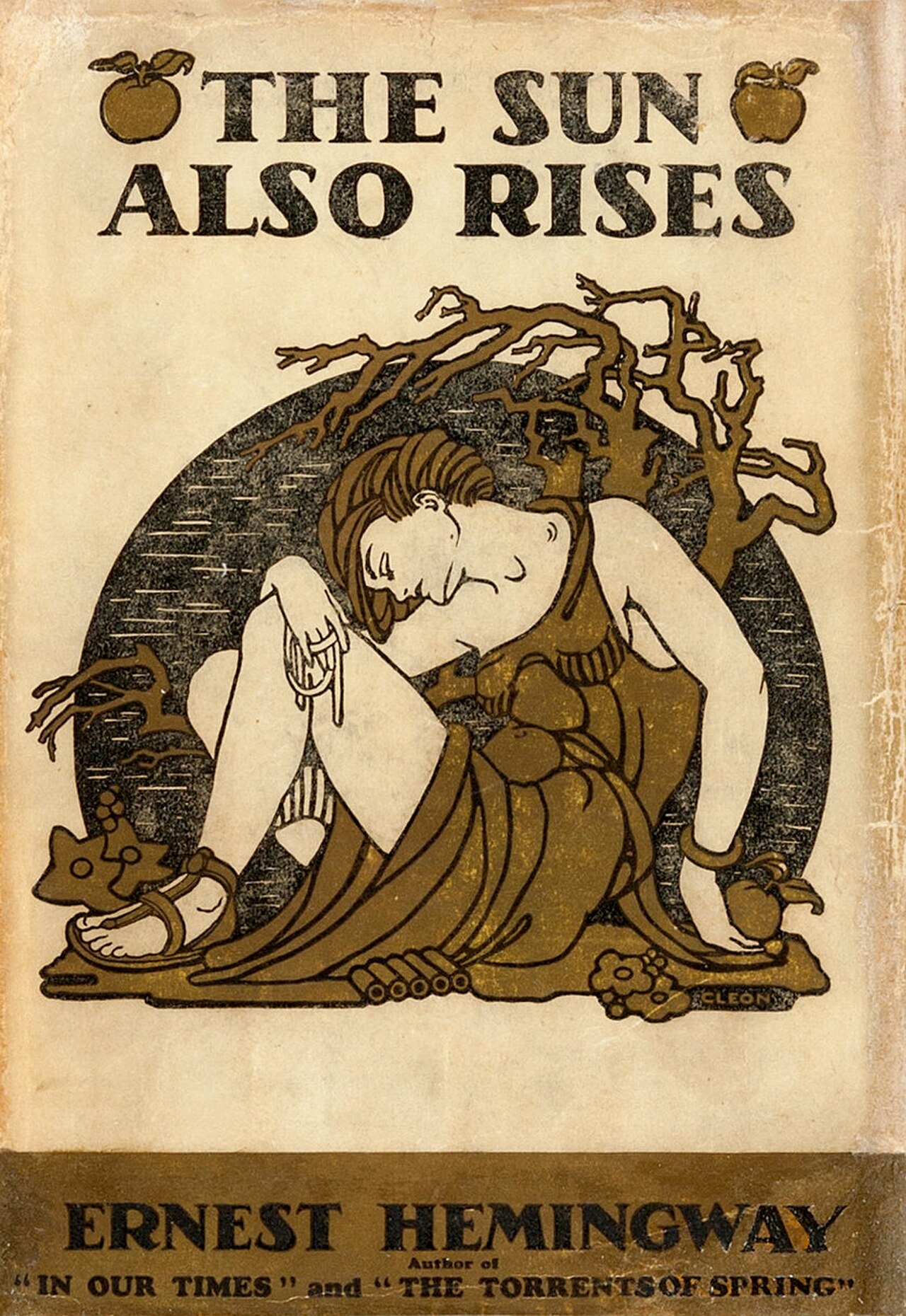
The original cover for “The Sun Also Rises.”
It is a book that has been continually read, studied, praised, condemned and argued over since that time. It has served as a bellwether registering shifts in critical approaches to fiction. I read a wide variety of critical articles about it while preparing this post. They have demonstrated for me that, like other great works of literature, it supports a variety of readings. Many of those I read contradicted one another, but each was well supported in its claims. It has also generated controversy related to the topics of race, gender, sexuality and antisemitism in literature. The Sun Also Rises is an established work in the American canon with the potential to endure, much like the earth itself, which Hemingway insisted in one of his letters was the actual hero of this novel. The novel has also generated interest also because it is a roman a clef (a novel with a key): a work in which the characters are based on actual people and events.
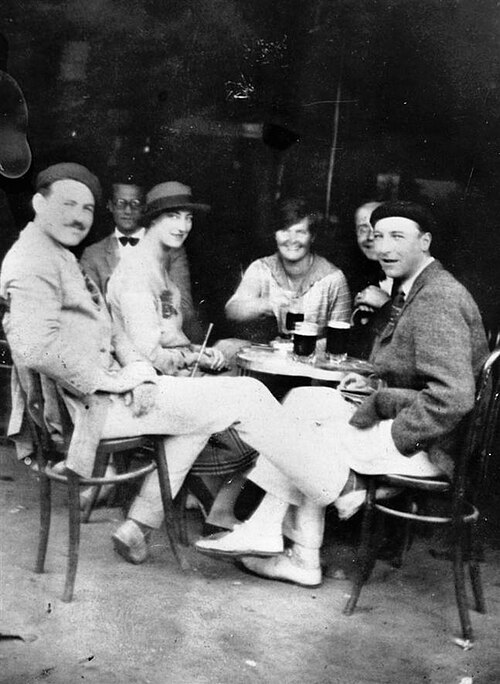
Left to right: Hemingway, Harold Loeb, Duff Twysden, Hadley Hemingway, Donald Ogden Stewart and Pat Guthrie at the fiesta in Pamplona in 1925.
The Hemingway public image is often associated with adventure of various kinds: fishing, hunting, combat: outward experience in the world. But Hemingway’s best work, while rich in vivid description of landscapes, bodies of water, and purposeful physical actions of its characters, also deeply probes human psychology, especially through implication below the surface of dialogue and action–what is known as Hemingway’s iceberg theory. What strikes me all these years later about The Sun Also Rises is its stunning freshness, is rendering of our disordered modern world while transporting us to France and Spain in the years of “The Lost Generation.” It is a strikingly modern portrait of what we now call trauma and dysfunction. Its characters’ drunkenness, hedonism, aimlessness, despair, ironic detachment and cynicism are familiar to many of us today. Several of them carry the inner scars of war, what we now call PTSD (post traumatic stress disorder), and take refuge in alcohol. Even in their togetherness they are isolated, lacking connection to meaningful community, family, and religion. They are some of the first washed up human wreckage on the shores of our 20th century modern literature. There are people like them today, wounded pilgrims on the road to Pamplona, searching for God, or meaning or a sense of purpose. Maybe we know some; maybe we were like them at some point but found a way out. Maybe we are all like them in some small measure as we navigate the disorientation of our own times.

Ernest Hemingway in Milan. Photo from the Ernest Hemingway collection at the John F. Kennedy Library.
I believe the world we know today essentially took shape around 1919. While American prestige abroad grew steadily since the late 1800s, the First World War made the U.S. a major power in world politics. The consumer economy became more deeply embedded in the United States. And while many longed for a return to old ways—think President Warren Harding’s appeals for “normalcy”– there was no going back to what had been. Reactionary forces seemed to have the upper hand. Prohibition was the law, but was widely flouted, breeding an atmosphere of hypocrisy and cynicism. Aimee Semple McPherson and Billy Sunday embodied a figure we know all too well—the slick popular preacher manipulating modern media to reach a wider audience. It was a time of increased social mobility and modern convenience rendering daily life easier, although many in rural America still lived by the sunup to sundown rhythms that governed their grandparents’ lives. The world was growing closer, smaller and more connected. It was a time when Americans flooded into France, where some chose to live as expatriates given a favorable exchange rate and the absence of onerous social controls like Prohibition.
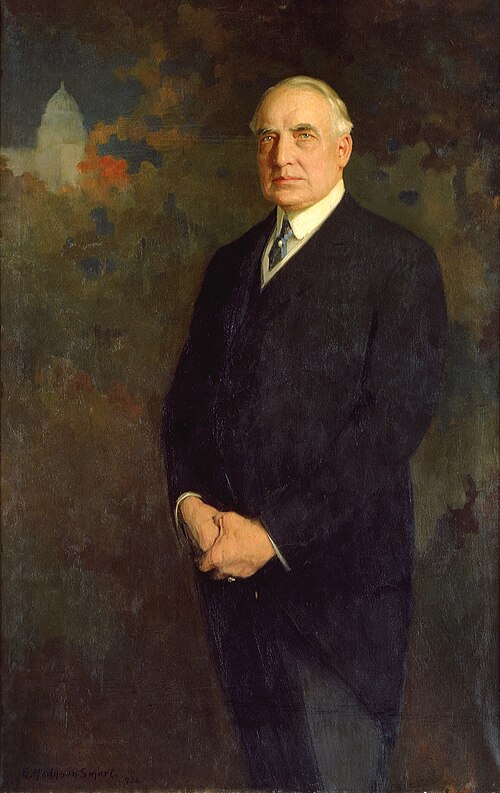
President Warren Harding of Marion, Ohio.
It is one of Hemingway’s best works, not only for its story, characters, and themes, but for its style, which would exert powerful influence for decades to come. One of its great stylistic virtues, including its remarkably clean composition, is Hemingway’s skilled use of his “iceberg theory.” This a practice of implication, creating deep tension by hinting at the unspoken below the surface of dialogue and action. It’s a technique by which the reader more clearly senses the massive weight under water. The novel features complex characters dealing with life in superbly rendered scenes of France and Spain, where the enduring earth and ancient cities and traditions form a backdrop to the modern scenes of anomie and despair. And what a sharply written novel it is. When I think of Hemingway working with his pencils and notebooks, I often think of a woodcarver slicing away slivers of wood and shaping it with deep vigorous strokes into the final creation. It is remarkably readable and superbly paced, the sentences moving swiftly from one to another. There’s a rhythm to it. Group scenes alternate with moments between Brett and Jake, or Jake with one or two male companions or times when Jake is alone.

Ernest Hemingway on the job in the 1930s.
These characters have no deep foreground, which seems appropriate since most drift from one place to another, unanchored to neighborhood or family. They seem born out of nowhere into modernity. The character with the most detailed personal history is Robert Cohn. But we know nothing of the origin families of Brett, Jake, Romero, Bill and Mike. There is very little physical character description, with the exception of Brett and Romero. Hemingway’s works are spare when it comes to physical descriptions of people, but his careful use of dialogue and description of behavior still create vivid characterization.
Some readers today might be surprised at how controversial this novel was when first published. While it drew good reviews, it was also condemned as a portrait of degeneracy. One of the fiercest critics was Hemingway’s tiresome mother, Grace Hall Hemingway, a woman with her own mental health problems, who described it as “one of the filthiest books of the year” and told her son that “Every page fills me with sick loathing–if I should pick up a book by an other writer with such words in it, I would read no more, but pitch it in the fire.”
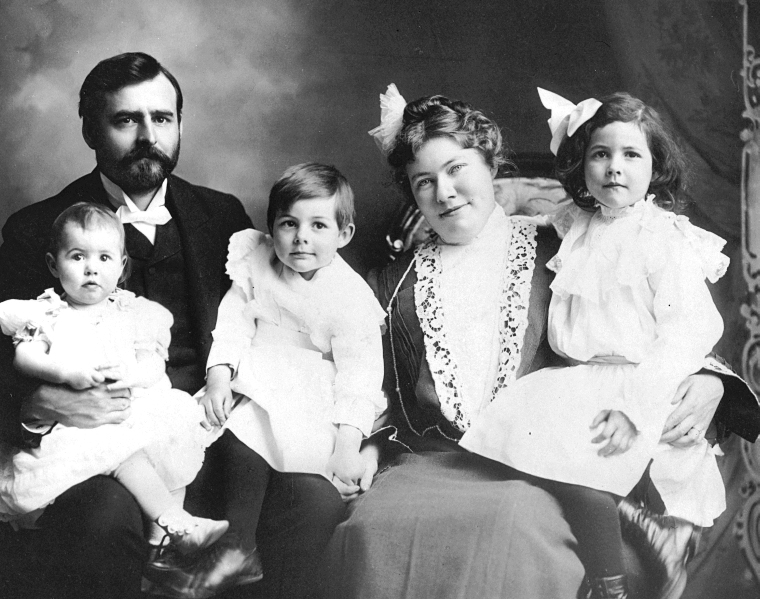
October 1903 Hemingway family portrait. L-R: Ursula, Clarence, Ernest, Grace, and Marcelline Hemingway. Photograph in the Ernest Hemingway Photograph Collection, John F. Kennedy Presidential Library and Museum, Boston.
This response tells us a lot about Grace Hemingway, but her son was far beyond her and Oak Park, Illinois. He waited two months before responding, noting that the book was unpleasant, but not entirely so, and that “the people I wrote of were certainly burned out, hollow, and smashed–and that is the way I have attempted to show them.” Modern readers and viewers are familiar with stories of alienation whose characters wander the night seeking relief from pain and despair. Gone are the days when alcoholism or drug addiction were topics discussed in a whisper, when movies like The Days of Wine and Roses or Lost Weekend caused a stir because they openly addressed alcoholism. We are used to stories of alcohol abuse and addiction, of drug dealers, drug trade and addicts. Many of us are familiar with the language of addiction and recovery from celebrity confessions, news coverage and talk shows. People speak openly of anxiety, obsessive-compulsive disorder and other mental heath concerns. This is all relatively new. I can still recall the initial shock when myself and millions of other Americans witnessed First Lady Betty Ford publicly admit her own alcoholism, a courageous move helping destigmatize the condition and promote treatment and public understanding. Public discussion of drug and alcohol addiction in general terms had occurred for decades, but by the late 1970s and after it was discussed more openly and intimately by prominent people who suffered from it. Hemingway’s works are full of drinking, and The Sun Also Rises is no exception. We have three characters who are alcoholics by any measure: Jake Barnes, Brett Ashley and Mike Campbell.
The legacy of WWI hovers over the book like a fading cloud of mustard gas. Barnes is a veteran, as are Bill Gorton, the English fisherman Wilson-Harris, Mike Campbell, and Brett Ashley herself, who served as V.A.D. (Voluntary Aid Detachment) nurse. Jake, Brett, and Brett have been severely damaged by the war.

A war weary Doughboy.
The Sun Also Rises is a city novel. The entirety of Book One is set in Paris: much of Book Two occurs in the city of Pamplona during the San Fermin festival. Events in Book Three occur in the city of San Sebastián. Uninhibited nightlife and scenes of carousing are frequent. Its portrait of postwar aimlessness and despair has led to comparisons with T.S. Eliot’s The Wasteland. Its characters are estranged from meaningful community life, religious faith and family connection. There is little family life in The Sun Also Rises. The book is shot through with religious allusions. Barnes is a Catholic who struggles to find meaning in his faith, at one point describing himself as “a rotten Catholic.” A century on when can still feel the power of its portrait of young people lost, drinking, moving from one frenetic thrill to another, but always moving on, restless, ever restless.
But this isn’t the only side of The Sun Also Rises. The book is full of life. I suspect countless readers have wanted to dash off to Paris and Pamplona after reading it. When I read it, I can see the cool waters of the Irati River, I can smell the spent gunpowder of the fireworks in San Fermin and the scents of wine, garlic, and tobacco. I can hear the roar of the crowd and the thundering hooves of the bulls running the streets, see the bold red scarves of the men running before them. I love this book.
In this post I take a deep look at this great Hemingway novel. I examine some of its key motifs and themes, discuss my own history with it as a reader across the years, and towards the end explore its roman a clef nature and the actual events that formed the basis for it. I also employ some Jungian concepts in exploring Hemingway’s great first novel.
ENCOUNTERING THE HEMINGWAY MAGIC:
It was an old, beat up cardboard box in an unused corner bedroom of our house where the magic was housed. I can still see the box. It was a pale green and white box from Velva-Sheen, a Cincinnati sporting goods company. It was packed full of paperbacks my three older brothers read in high school. When I was around twelve years old I began leafing through those books. I spent many an hour browsing through them. The box was in a closet next to a westward facing window where the sunlight spilled in during late afternoon and early evening. Inside was a copy of The Old Man and The Sea and The Snows of Kilimanjaro and Other Stories, both of them Scribner paperbacks, stacked alongside works by Mark Twain, Emily Bronte, Albert Camus and a variety of other authors. I still have many of these books, including the two Hemingway titles. The edition of The Snows of Kilimanjaro and Other Stories features one of the iconic impressionistic covers of Hemingway’s books by artists James and Ruth McRae, an oil painting on board rendered in muted blue, gray, green, yellow and cream illustrating three tents and a tree at the base of the mountain. Three birds fly overhead. This cover always takes me back to that discovery of Hemingway. Other covers in this style–which I would encounter in used bookstores and thrift shops in years to come–always evoke for me the grand mythic world of Hemingway and my excitement learning about him.
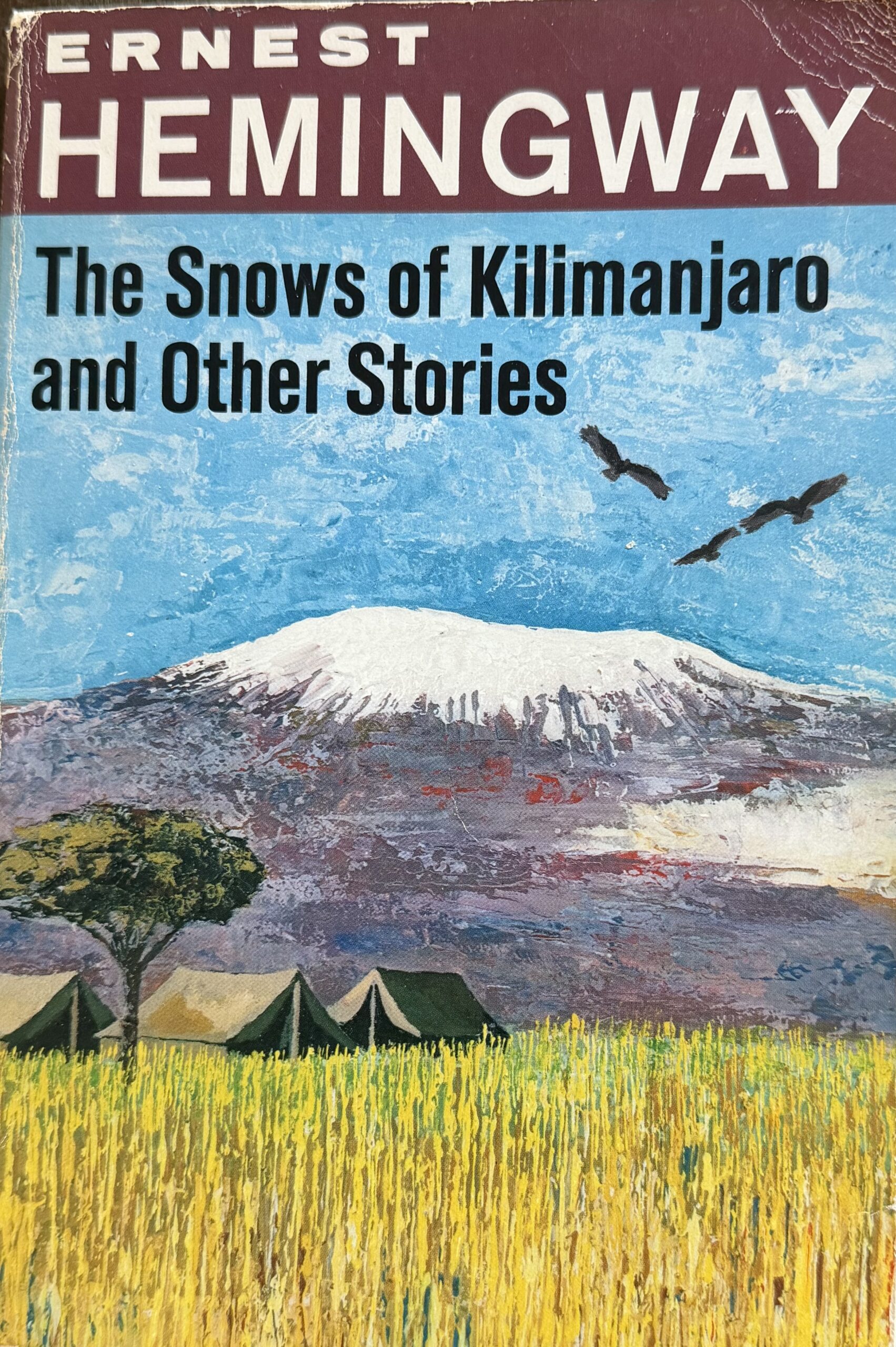
A relic from the Velva-Sheen box. Our old copy of “The Snows of Kilimanjaro and Other Stories” (author’s photo).
The facts about Ernest Hemingway were simply stated on the back cover of The Snows of Kilimanjaro and Other Stories. I can practically recite them to this day:
“Born in Oak Park, Illinois, in 1899, Ernest Hemingway was educated there in the public schools. He became a reporter on the Kansas City Star and in World War I served as an ambulance driver and infantryman with the Italian army. After the war he settled in Paris as a correspondent for the Toronto Star and it was there he began his serious writing career. He served as a war correspondent during the Spanish Civil War and World War II. In 1954 he was awarded the Nobel Prize for Literature. He died in Idaho in 1961.” Next to this was a portrait of a bearded, grinning Hemingway in his later years.
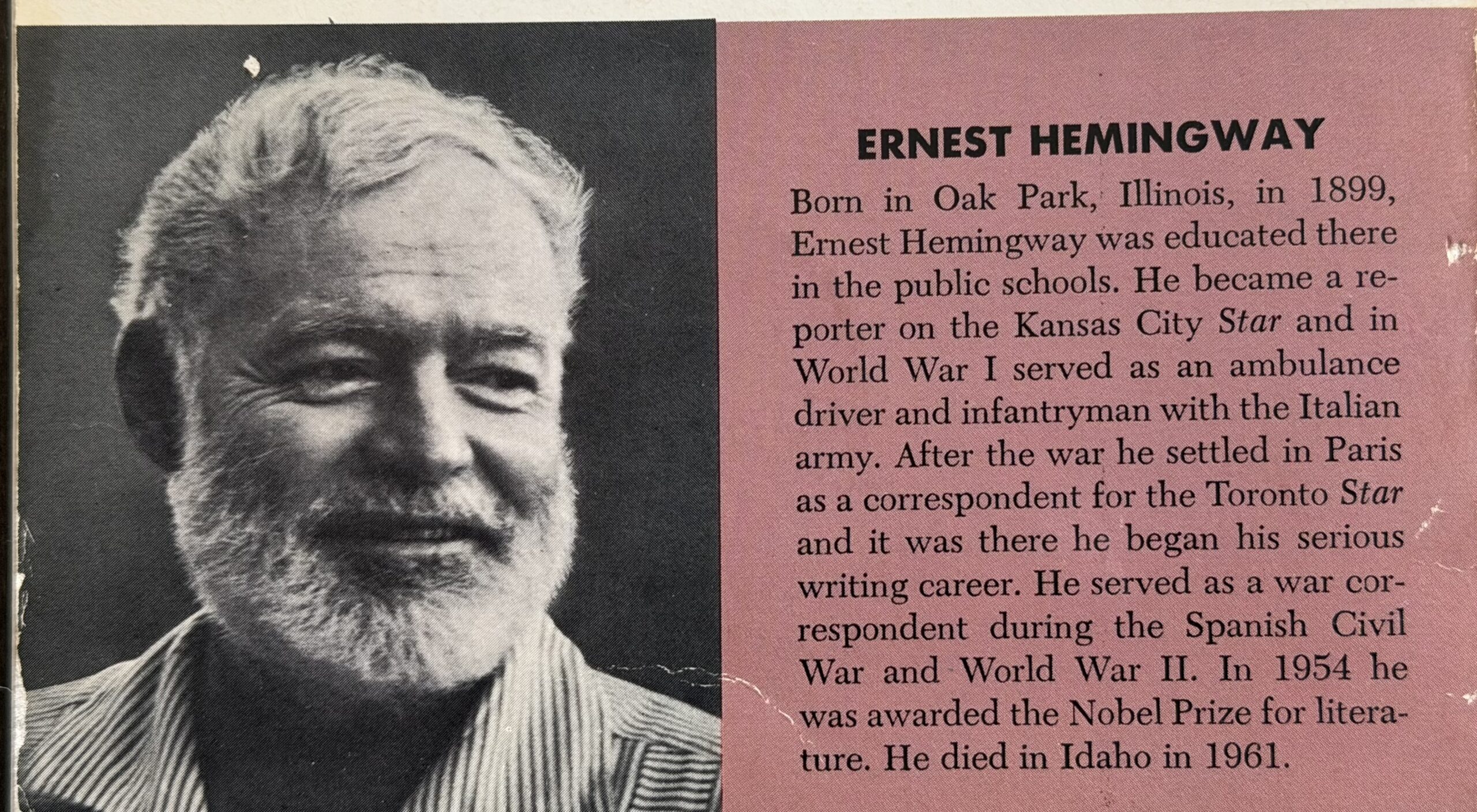
The bio of the legend (author’s photo).
There is a minor error of fact here. Hemingway was a Red Cross driver on the Italian front, not an infantryman, but that biography conveyed a sense of international adventure, war and literary renown. Titles were also listed on the back. They were striking, having a terseness that seemed part and parcel of the legendary prose style. Winner Take Nothing. To Have and Have Not. A Farewell To Arms. There was something especially powerful about the title In Our Time, which seemed to evoke the drama-filled, war-torn sweep of the 20th century.
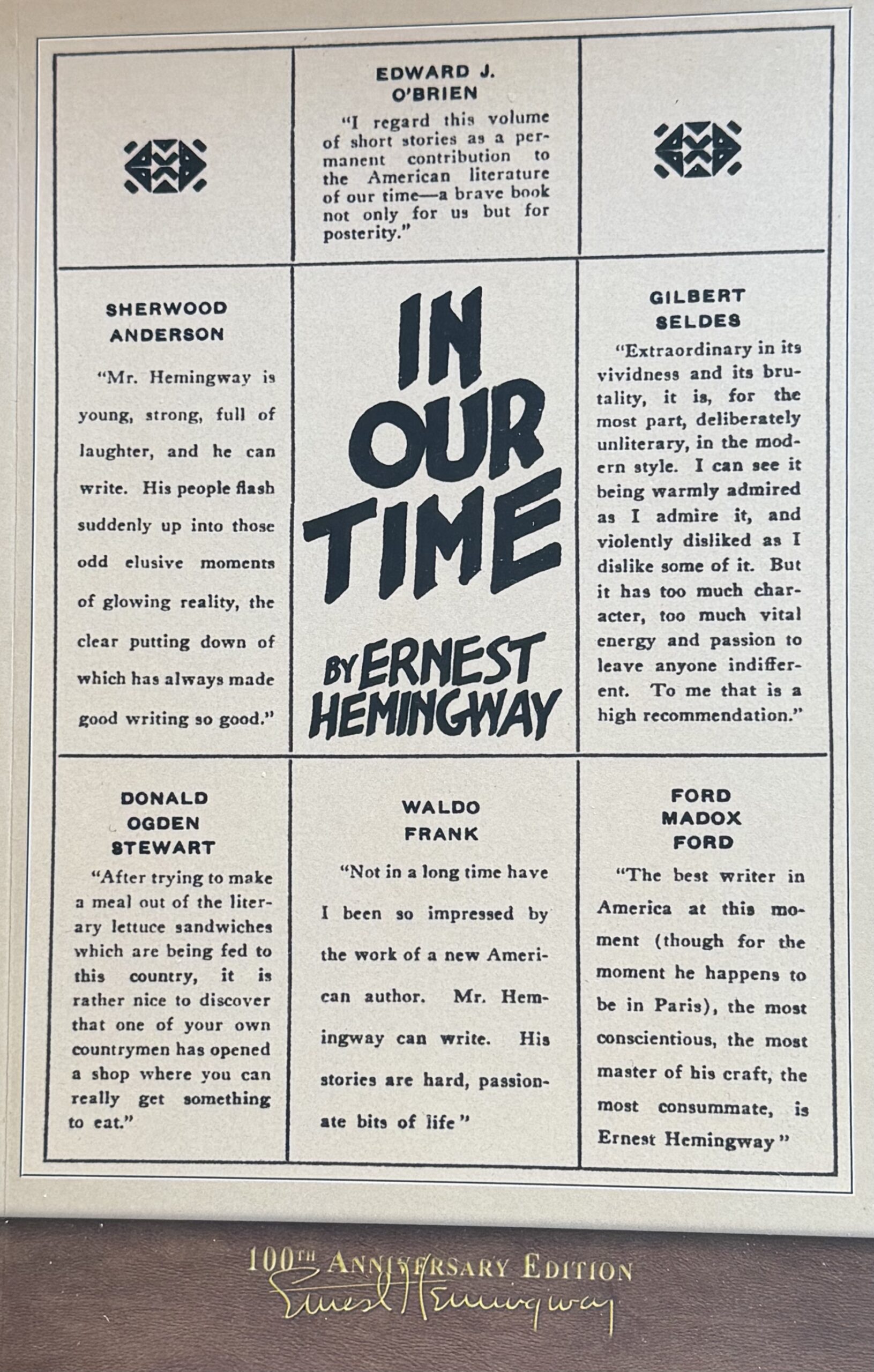
A recent purchase: “In Our Time” with a facsimile of its original cover (author’s photo).
I got the feel of a remarkable life just from reading that little biography. In that corner bedroom of our suburban home, the westward facing window felt like a portal into a world of war, women and adventure when I perused his books. And what a world he inhabited: outdoor adventure as a boy and young man in the rugged northern Michigan country, a spell as a reporter on the Kansas City Star right out of high school. Service on the Italian front in WWI as a Red Cross ambulance driver, where he was badly wounded and romanced Agnes von Kurowsky, the inspiration for his 1929 novel A Farewell To Arms.
The years as a correspondent in Europe and life in 1920s Paris, forging friendship with people ranging from Scott Fitzgerald, Gertrude Stein, and Ezra Pound to Ford Madox Ford, Picasso, and James Joyce. Deep water fishing in Florida, big game hunting in Africa. War correspondence in the Spanish Civil War, and then during WWII, where he crossed a dangerous line from correspondent to leader of a ragtag band of French partisans.

Agnes von Kurnowsky (Image: Pinterest).
I was a middle school kid when I first poked around in the green and white Velva-Sheen box. In the spring of seventh grade I became seriously interested in classic American literature. One rainy Saturday afternoon in April I checked out a couple of his other books in the Greenhills Branch Library in Greenhills, Ohio. In those days I just sort of skimmed these books, not quite ready for literature of this depth. It wouldn’t really be until my freshman year of high school that I began to explore Hemingway’s work. I read The Old Man and The Sea and the short stories in The Snows of Kilimanjaro volume.
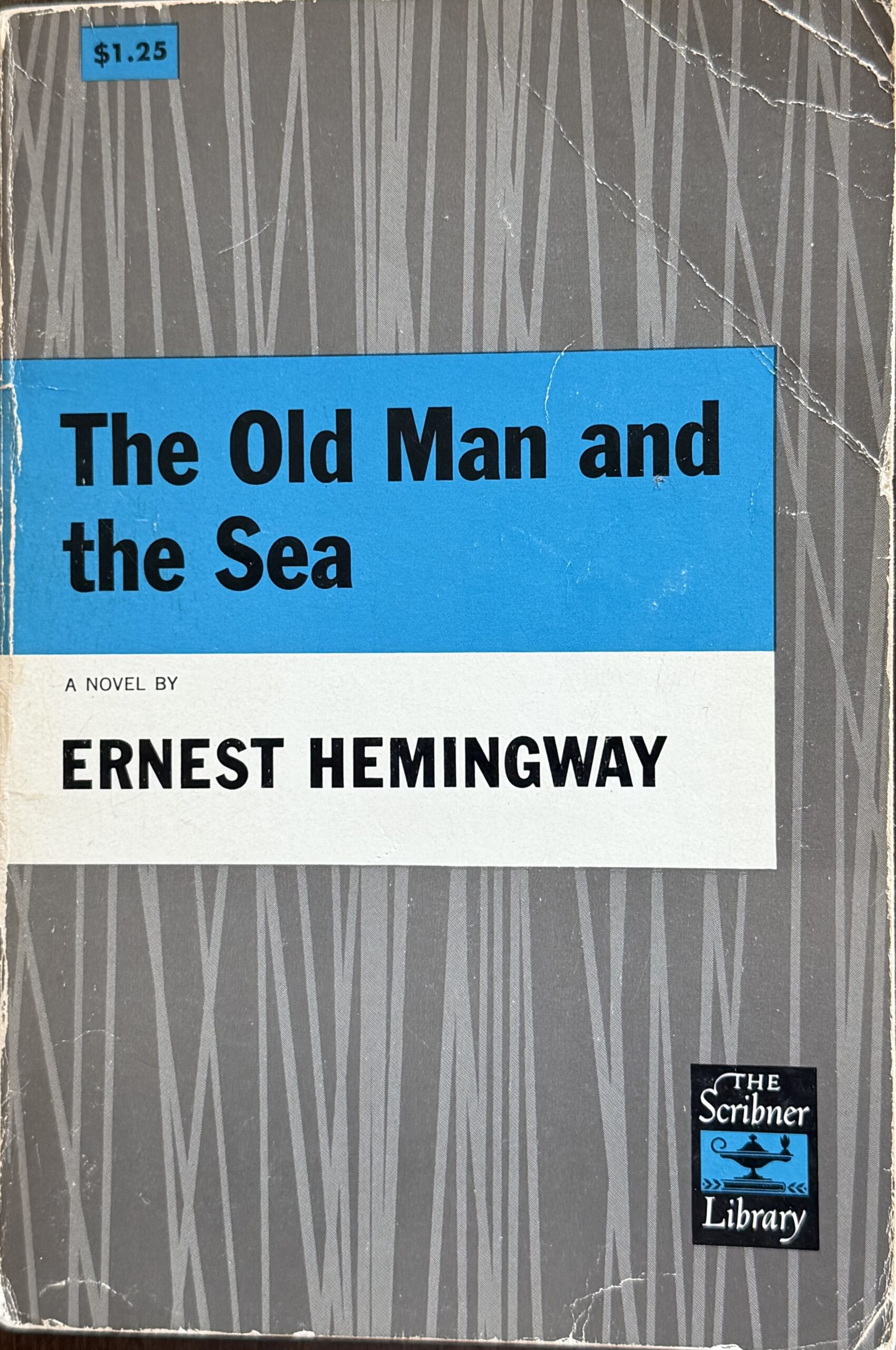
Our old family copy of Hemingway’s Pulitzer Prize winning novel (author’s photo).
One Sunday late afternoon that year I plunged into his famous memoir A Moveable Feast I had found at a used bookstore in a nearby suburb. Later on during my high school years I read The Nick Adams Stories, but I had already begun to read more of his contemporaries: Joyce, Thomas Wolfe, John Dos Passos and John Steinbeck, and Hemingway took a rear seat—for a while.

John Steinbeck
But Hemingway seized hold of me again, this time in 1985 as a University of Cincinnati freshman who had just switched his major from communications to English literature. One of the books on a class reading list was The Sun Also Rises. I lived at home for my first two years of college, a young man at loose ends. The long structured world of high school was over. I was intimidated by the college world. Although I was an omnivorous reader and budding writer, the English department world felt strange. The professors struck me as weird tweedy guys who were detached from what I, in the deep wisdom of eighteen, thought was “the real world.” I would soon learn how callow I was and come to appreciate the UC English department.
I was a quiet young guy skulking around in a black leather jacket, a devotee of Kerouac and Ken Kesey. I had moved away from the interwar period and was drawn more towards the innovative postwar writing of the 1950s and 1960s. I was deep into the Doors, Talking Heads and other bands from the 1960s and the New Wave scene of 1985. Soon I would read novelists like Don DeLillo and Thomas Pynchon. But during the spring of 1985 I thoroughly enjoyed a course on twentieth century American fiction. The professor had served as an Air Force officer and taught at the Air Force Academy. One of those books was The Sun Also Rises. I enjoyed going back into the world of the earlier twentieth century under his tutelage. The memory of that first reading is clear: days in late winter and early spring.
As a high school boy I was taken with the mythos of Hemingway. Later I learned his life was complex and troubled. I saw what a colossal pain he could be for people around him. The fact he killed himself made me wonder about the reality of the man. As the years went by I learned more about him. There was plenty that troubled me, but I have always tried to see Hemingway with perspective. I always come back to a quote from his first wife Hadley, who essentially said that he had more angles than geometry. I saw it as I read more about him. A cringeworthy anecdote that had me rolling my eyes would be followed by an account of tenderness and vulnerability.
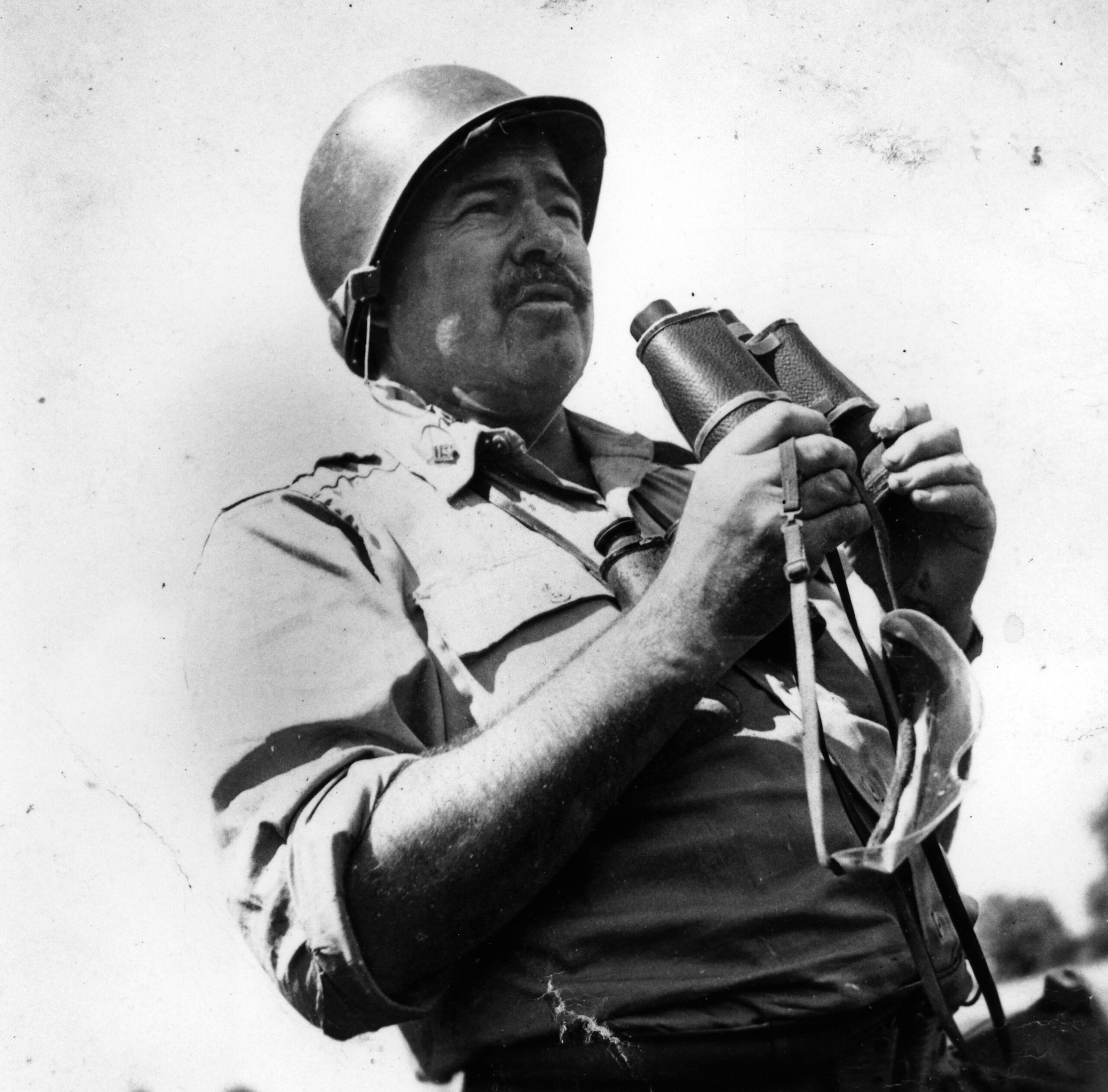
Hemingway at his most dangerous. He violated the rules of combat correspondence by taking up arms and leading a group of French partisans. He could have been executed by the Germans if captured. Other correspondents complained about his activity and he narrowly escaped court martial. “Ernest Hemingway Collection/John F. Kennedy Presidential Library and Museum, Boston.”
Hemingway was born in 1899, right at the end of the nineteenth century. He was on hand for some of the new century’s most tumultuous times. He experienced both world wars. He traveled widely; as he became famous his exploits made for good copy. He covered the Spanish Civil War. He knew or met many of the great writers, artists and performers of his time. Even a partial list of people of his acquaintance is a roll call of twentieth century culture: Ezra Pound, Scott Fitzgerald, James Joyce, Sherwood Anderson, Pablo Picasso, Ava Gardner, Gary Cooper, Marlene Dietrich. Ava Gardner, incidentally, would portray Brett Ashley in the first film version of The Sun Also Rises.
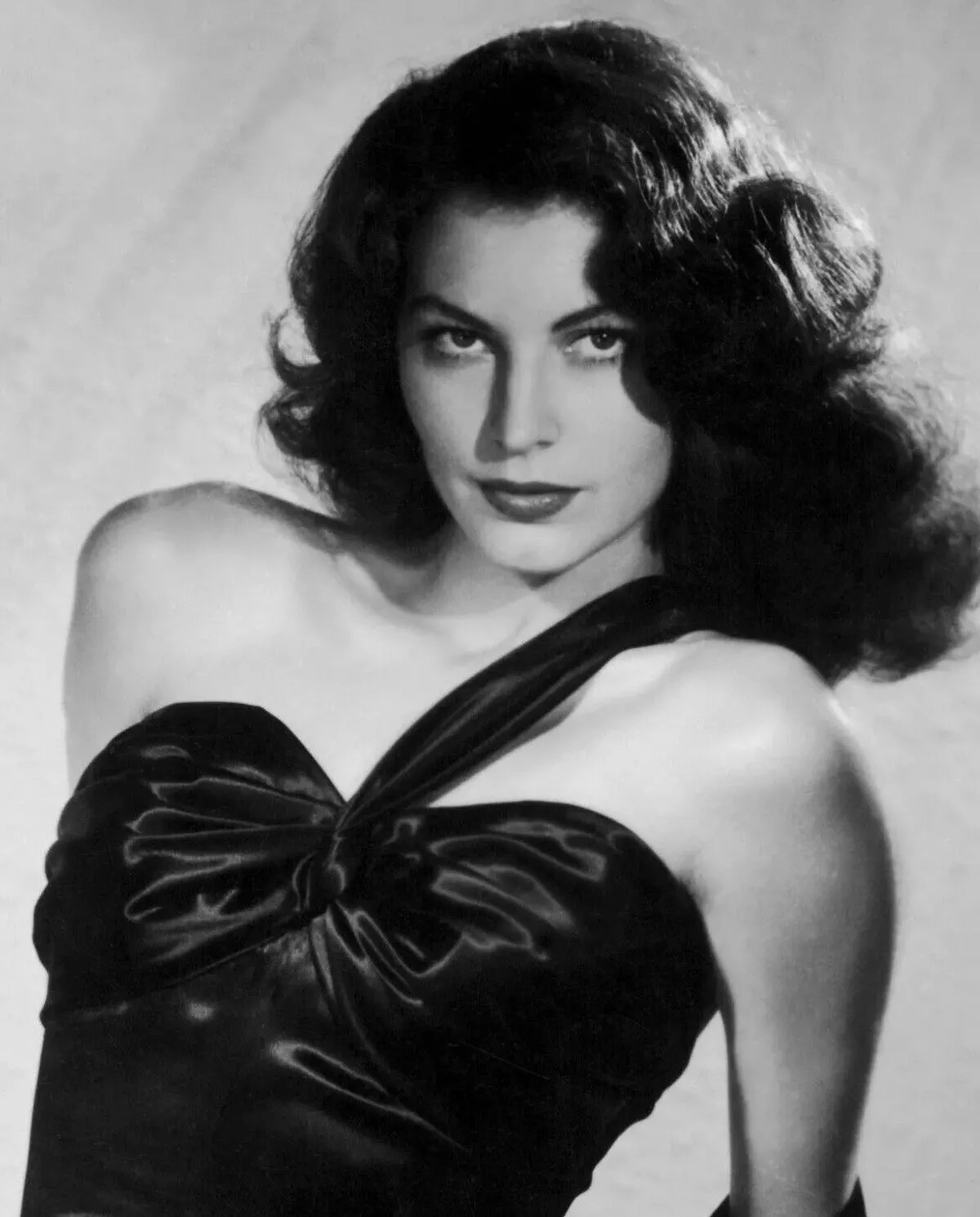
Ava Gardner.
He was part of the legendary expatriate circles of Paris in the 1920s, when that city was the nerve center of innovation in the arts. He drank with Scott Fitzgerald, boxed with Ezra Pound and attended Gertrude Stein’s salons. Paris, for the expatriates, seemed like the center of the universe. Americans flocked there for its culture, its excitement, its exchange rate, its access to alcohol of all kinds that had become verboten in Prohibition era America. Hemingway famously recorded that time in his memoir A Moveable Feast.
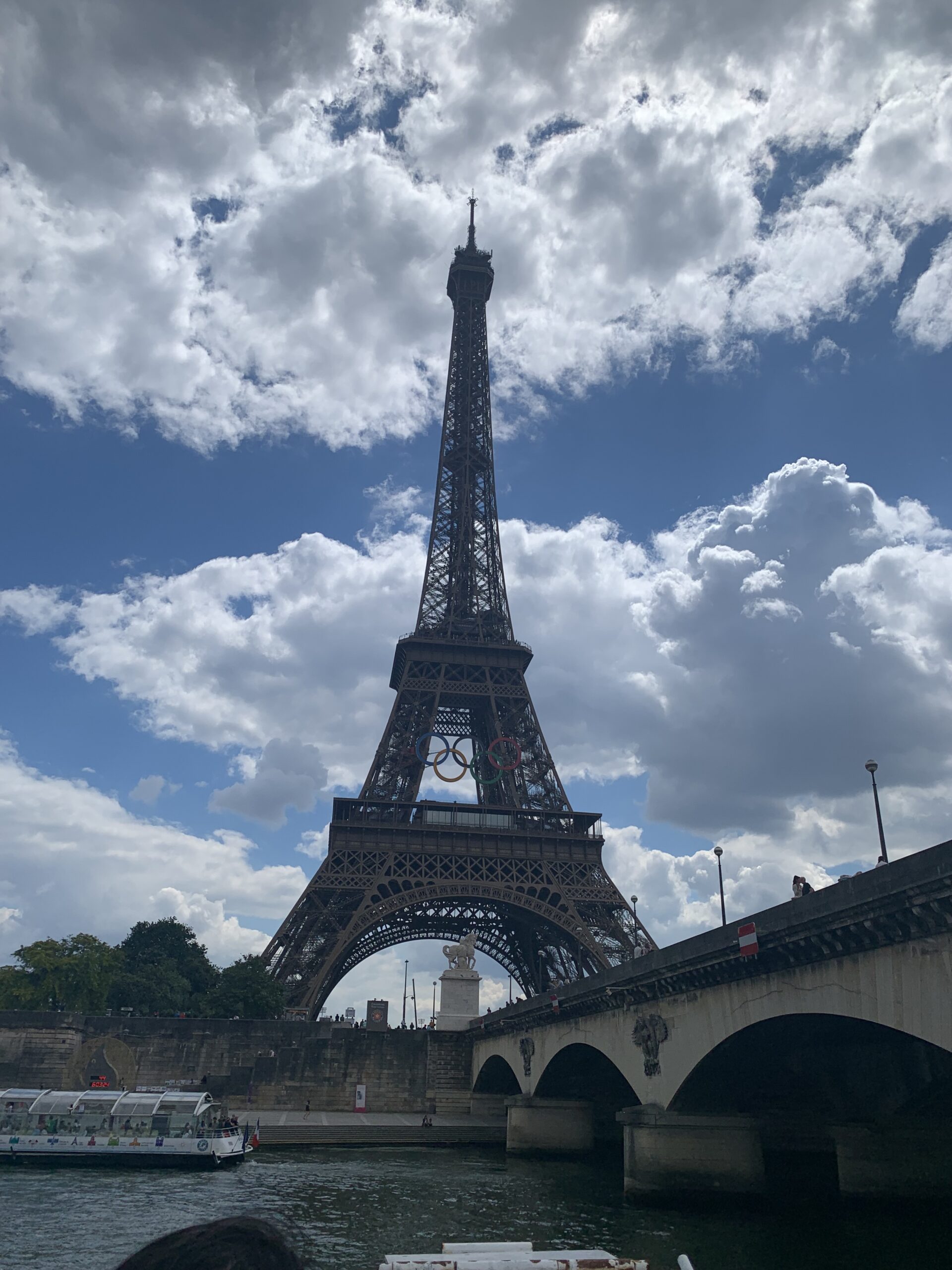
The Eiffel Tower, June of 2024 (author’s photo).
The photos of him have a legendary quality and have become iconic over time, published repeatedly in biographies, articles, on book covers and now in online forums: the handsome young Red Cross ambulance driver in his uniform. The beefy, moustached writer at his typewriter. Hemingway in his turtleneck sweater. The serious young writer staring out of his passport photo.
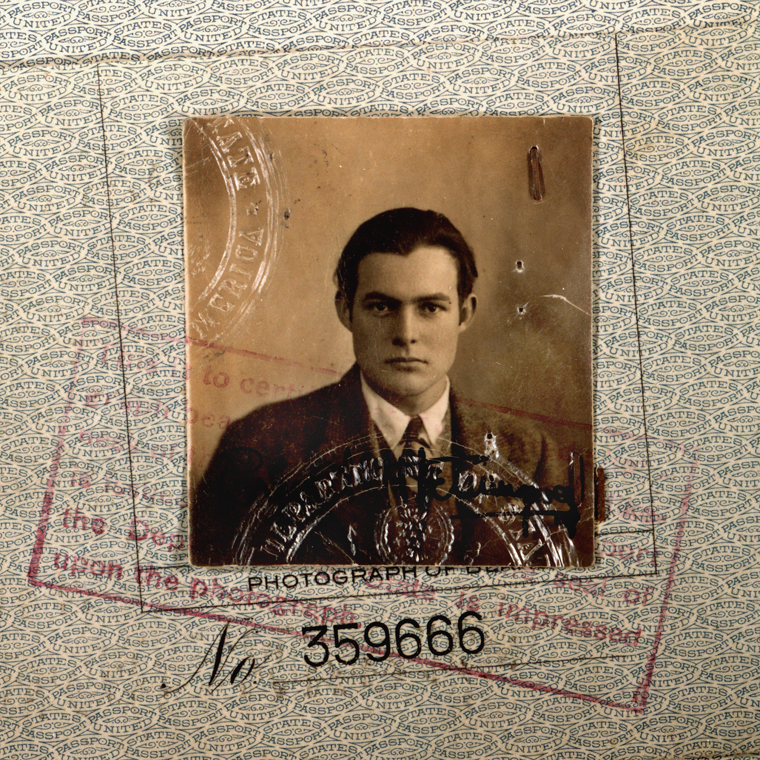
On the road: Ernest Hemingway, 1923 Passport. Ernest Hemingway Collection, John F. Kennedy Presidential Library and Museum, Boston.
His legend carries with him an aura of bygone times, an era when traveling to Europe meant going by ship. But the man didn’t age well. He won the Nobel Prize in 1954 and the Pulitzer in 1953, but he seemed out of place in the postwar world of television and atomic power. By the mid 1950s he was physically in deep decline. He was only sixty-one when he died, but he looked fifteen years older. The years of drinking, concussions, and other physical injuries took their toll. Hemingway’s mental and physical health have inspired a number of books and articles in recent times. The author of one study believes Hemingway suffered mightily from traumatic brain injuries from repeated concussions. Other retrospective diagnoses make the case for serious depression and bipolar disorder. Hemingway did undergo electroshock therapy at the Mayo Clinic. Hemingway also appears to have suffered from hemochromatosis, in which the body absorbs too much iron into the blood, leading to a variety of problems. A number of people in his family had this disease. He took his own life, as did his father, a brother, a sister, a granddaughter and his third wife, Martha Gellhorn.
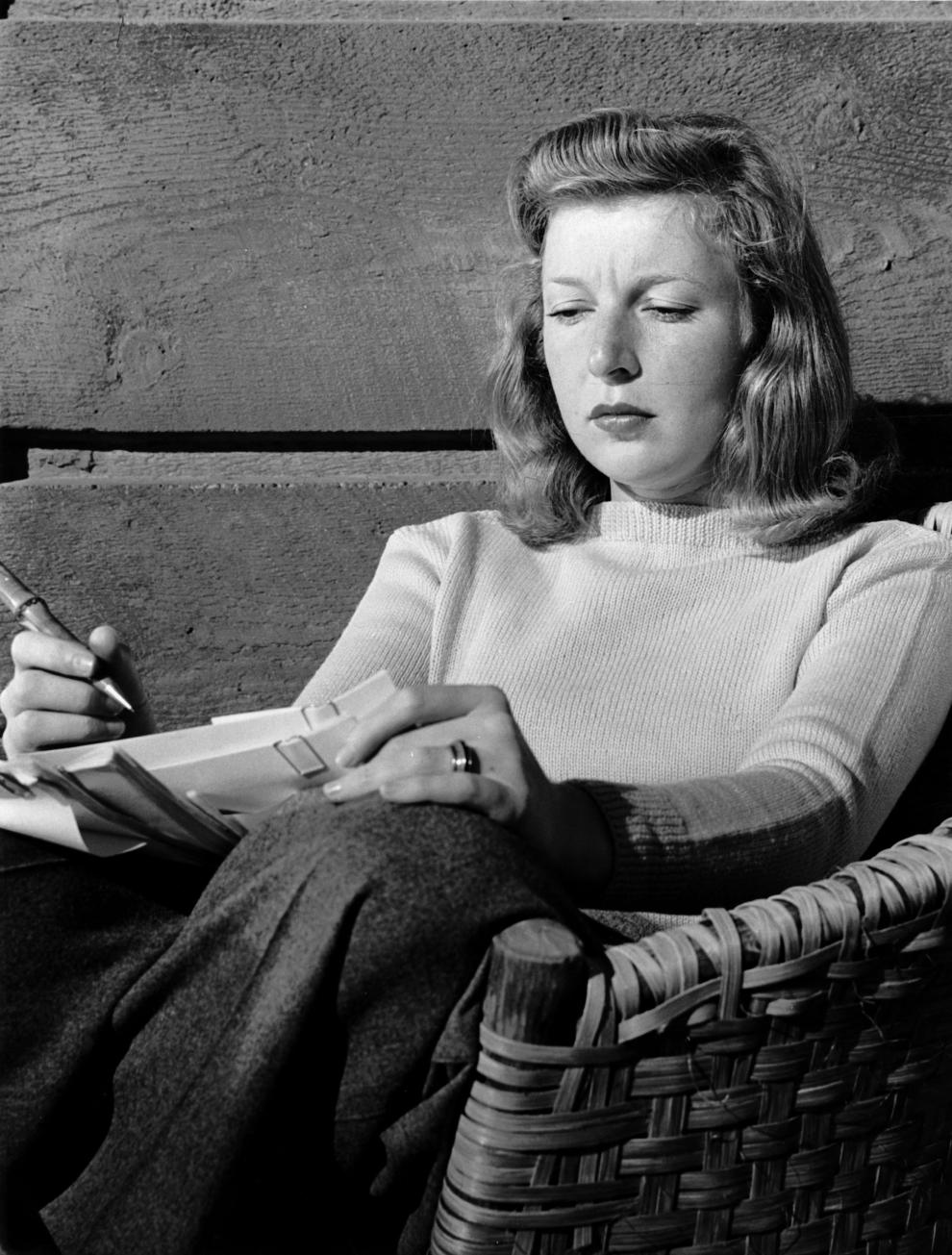
Martha Gellhorn
Now he is part of our collective cultural memory. Books about Hemingway continue to appear, people tour his home in Key West and the family home in Oak Park, Illinois. I can recall a “Hemingway Furniture Collection” that the Thomasville company unveiled back in 1999, the centennial of his birth. However, quietly persisting beneath the tide of biographies, articles and films are the books themselves, and one of his best is The Sun Also Rises.
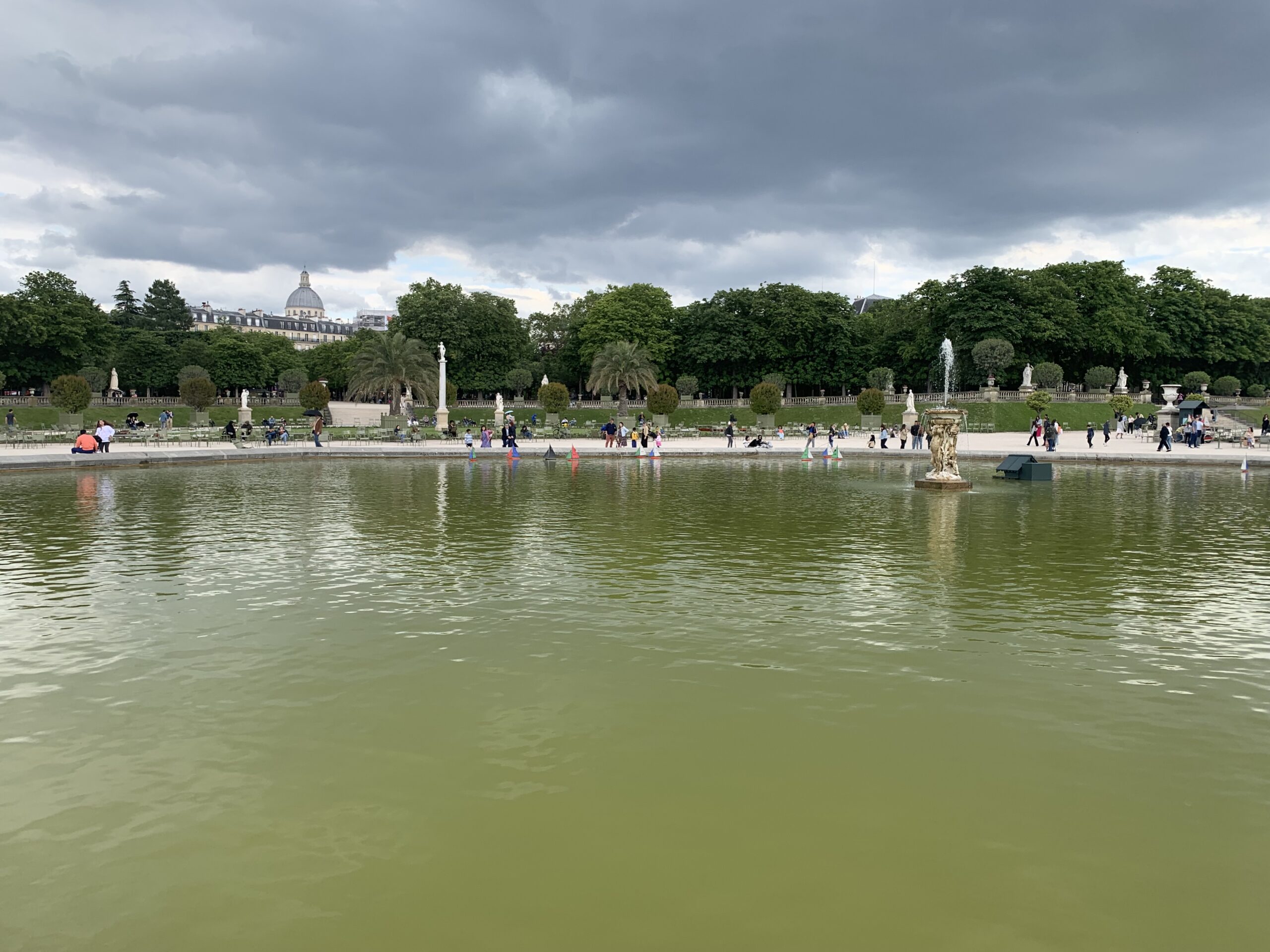
Luxembourg Garden, June, 2024 (author’s photo).
Many of us don’t just read and enjoy books. We are like lovers with them. They seep into the fabric of our lives; they are intertwined with the memories of certain times or seasons. There is a slate gray March cloudiness that hovers over my memories of first reading this book, a cloudscape that wove itself into my imaginings of France and returned to mind when walking through Luxembourg Gardens in Paris on a cloudy June afternoon nearly forty years later with my wife and daughter. The origin of the association is a March afternoon in the weird transition season from winter to spring. I was talking with some friends in my old high school parking lot. I had been enjoying reading the book at UC and the coolness of the March weather and the filtered sunlight of the day became part of the landscape of memory. It serves as a kind of visual shorthand that signifies the pleasure of reading this book of Hemingway’s. Certain days in March immediately summon this time to mind.

Luxembourg Garden on a cloudy day in June, 2024 (author’s photo).
I would not read it again for forty years. I read other works by him, but while recovering from surgery in the early months of 2025 I decided to reread it. The pleasure was there once more, and years of reading, writing, thinking and study had strengthened my critical faculties. More than that, years of living deepened and broadened my experience of the book. I reread it once more in early 2026 along with a large selection of critical articles in preparation for this post, and I am convinced of its permanent place in the canon of twentieth century American literature. The Sun Also Rises recalls the statement of Hemingway’s friend and Paris colleague Ezra Pound: “Literature is news that STAYS news.” The idea I find especially relevant to The Sun Also Rises--its depiction of endless drinking, pleasure seeking, ennui and a search for solid spiritual ground to stand on seems more relevant than ever.
A testament to the The Sun Also Rises as a work of art is its manifold richness, allowing a wide range of critical responses to be drawn from its pages. Who is the main character of this novel? Is it Jake or Brett or Robert Cohn? Is Brett an empowered New Woman, someone who makes her own choices about her body and relationships as so many men have, or is she Circe? It has been described as a work about Catholic pilgrimage, a portrait of damaged humanity in the wake of WWI, a takedown of modern meaninglessness, a celebration of hedonism–the list goes on and on. And the able critic or commentator can usually make a strong case for their argument.
THE WOUNDED QUATERNITY: ROBERT, JAKE, BRETT, AND MIKE
These four characters are the most troubled in The Sun Also Rises, so I will examine them in depth. I alternate between using their first and last names.
ROBERT COHN
Although Jake Barnes narrates this book, we first learn about Robert Cohn. Jake begins by writing, “Robert Cohn was once middleweight boxing champion of Princeton. Do not think that I am very much impressed by that as a boxing title, but it meant a lot to Cohn.” Right from the start we can feel the resentment Barnes has for Robert, and while he may not be impressed by that title, he encounters Robert’s pugilistic power later on. Much of the first chapter is devoted to describing Cohn and his background. We learn that Cohn comes from a wealthy Jewish family, was married, had three children and later divorced his wife. He inherited money, much of which was lost, but took some of the remainder and backed and then edited an arts magazine, first in California and later in Massachusetts. What really infuriates Barnes the most about Cohn is his brief affair with Brett Ashley, the woman Jake loves. The complication with Brett is Jake’s war injury–he is impotent.
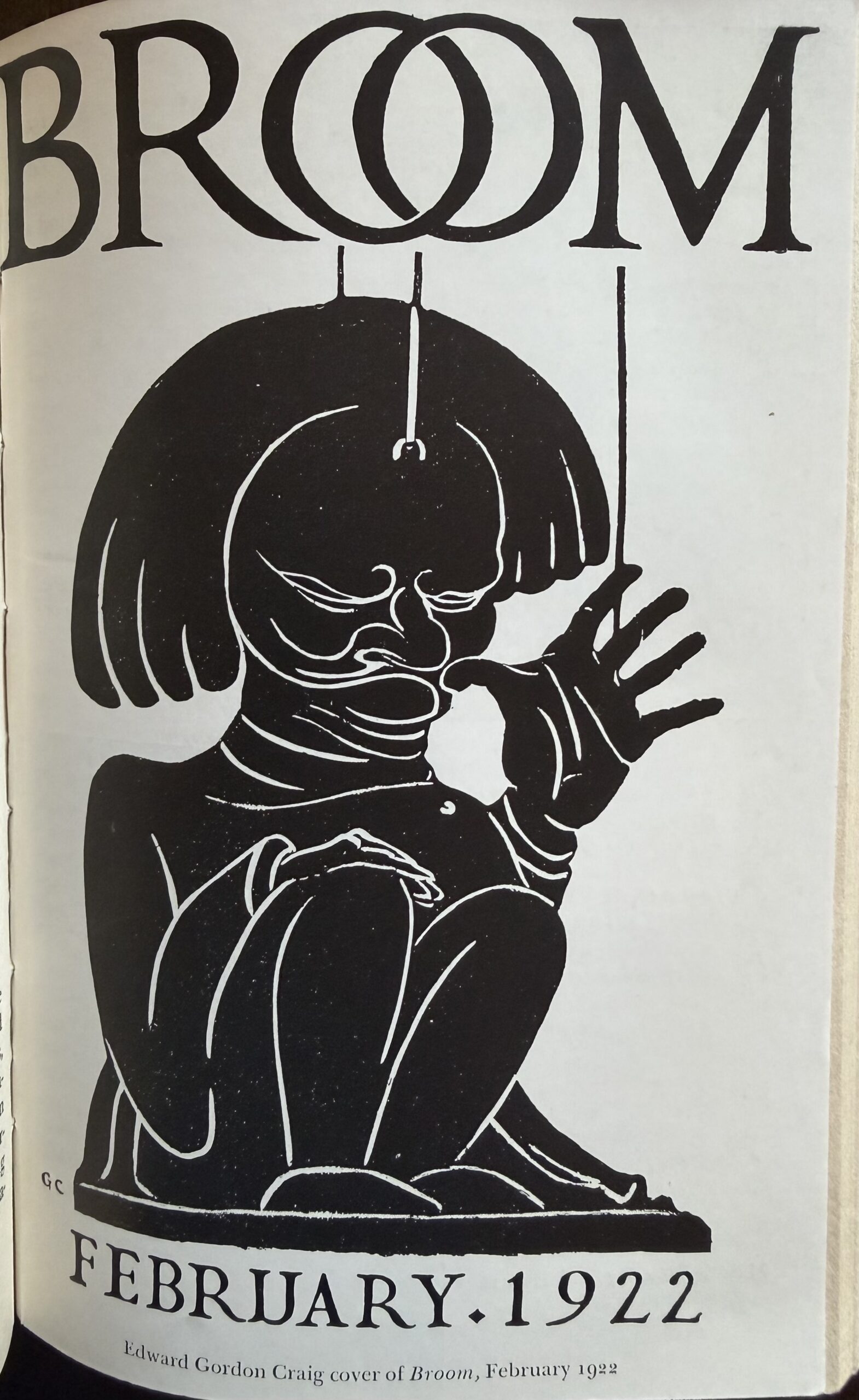
Cover of “Broom,” an important little magazine edited by Cohn’s real life counterpart Harold Loeb.
Cohn is repeatedly the target of anti-Semitic insults by other characters, usually out of earshot, being referred to as “that Jew” or a “kike.” The nature of Barnes’s feelings for Cohn are ambiguous at times throughout the novel. Early in the book Barnes says, in connection with Cohn and his lover Frances, “I rather liked him and evidently she led him quite a life.” As other scholars have noted, there is a kind of doubling in relation to Cohn and Barnes, a topic I will address later. Both men are writers. Both played football when younger. Both are powerfully drawn to Brett Ashley. However, there are deep differences between the two men, aside from the fact one of them gets to sleep with Brett. Cohn is not a veteran, which matters in this novel.
Although Harold Loeb, the real-life inspiration for Robert Cohn, served stateside in the U.S. Army during WWI, his fictional stand-in’s non-veteran service sets him apart from all the other major expatriate characters in the novel. Mike Campbell, Jake, and Brett–who served as a nurse during the war–are veterans who incurred physical or psychological damage or both. While the damage is obvious with these three, Hemingway’s iceberg theory approach hints at trauma for Jake’s friend Bill Gorton and Wilson-Harris as well. Gorton turns to humor and sarcasm to deal with the world. Wilson-Harris is a kindly man who is grateful for his time with Bill and Jake in Spain and says his time with them has been his best experience since the war ended. They share the comradeship of old soldiers.
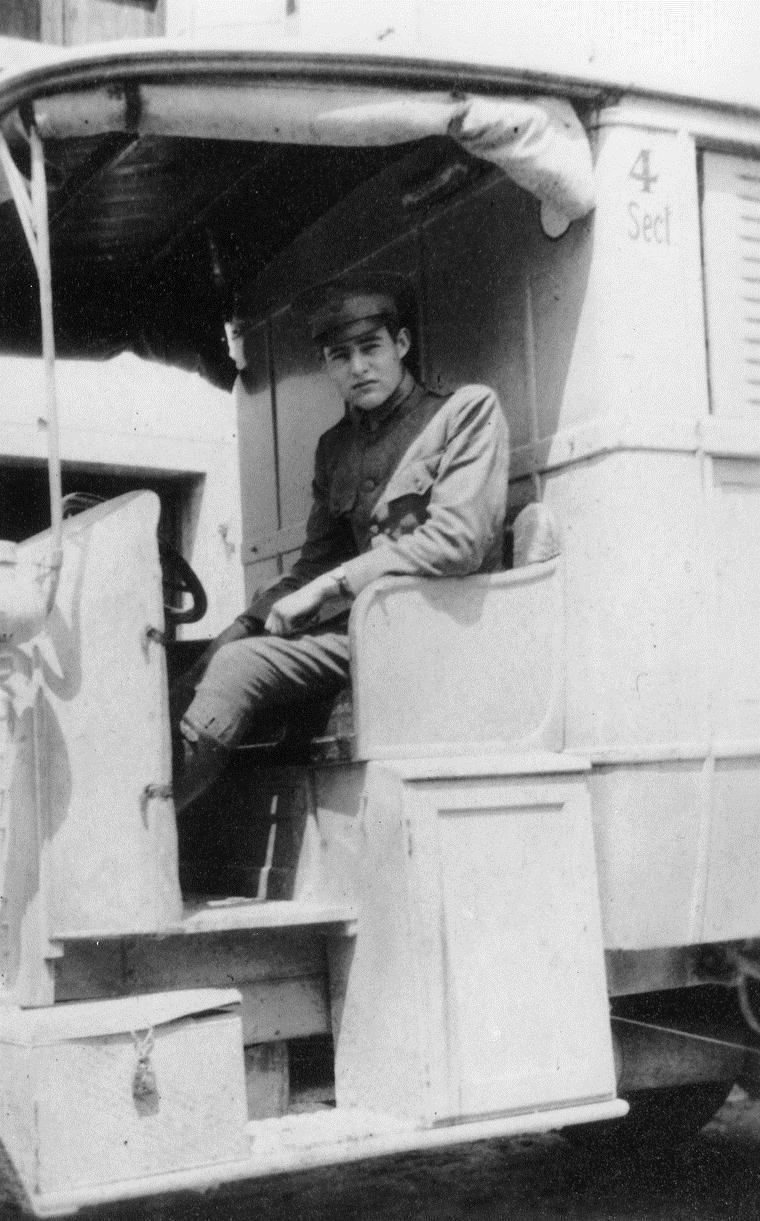
Hemingway as a WWI Red Cross ambulance driver.
One of the biggest gripes other characters have about Cohn is his tendency towards romanticism and naivete. Barnes is particularly irritated that Cohn is reading the English novelist W.H. Hudson’s The Purple Land, a book Barnes claims “is a very sinister book if read too late in life. It recounts splendid imaginary amorous adventures of a perfect English gentleman in an intensely romantic land, the scenery of which is very well described. For a man to take it as a guide-book to what life holds is about as safe as it would be for a man the same age to enter Wall Street direct from a French convent, equipped with a complete set of the more practical Alger books. Cohn, I believe, took every word of “The Purple Land” as literally as thought it had been an R.G. Dun report. You understand me, he made some reservations, but on the whole the book to him was sound.” Here we see some foreshadowing of Cohn’s romantic projection onto Brett Ashley. There’s a bit of metafictional irony here. Cohn is a gentleman who will have an amorous adventure in an intensely romantic land, and the scenery of that land will be well described by none other than Jake Barnes.

W.H.Hudson
He is an outsider to this group, marked not only by his Judaism, but also by his non-veteran status and his outlook on life. He doesn’t understand the values and experiences of the others. Cohn harkens back to a pre-war world of outdated romantic virtues. He has a prep school sense about him that is easily offended. He and Jake get into an argument in chapter five when Cohn asks Barnes about Brett Ashley. Jake gets tired of Robert and tells him to “go to hell.” Robert stands up, furious and demands that Jake “take it back.” Barnes thinks Cohn’s upset about his comments about Brett and tells him to “cut out the prep school stuff,” but Cohn is upset about being told to go to hell. He immediately sits down and smiles when Jake apologizes, but Jake is wary about Cohn’s behavior, wondering “What the hell would he have done if he hadn’t sat down?” Barnes is a potential Hemingway code hero. Cohn is not. Robert’s red flag behavior in this scene indicates a lack of self control and maturity. Jake will later find out what can happen when Cohn goes into a rage.
Cohn’s “prep-school” values are evident throughout the book. He sees himself as a knight-errant protecting the lady he’s fallen for. This is nonsense to Brett. He doesn’t understand that Brett sees their brief sexual relationship as a transactional business and isn’t interested in romance. He follows Brett around in a pathetic fashion, bothering her and the other characters. He seems to be looking for their approval. At one point in Pamplona Brett and Jake go off for a while to talk after a bad scene with Mike and Robert at a bar. Brett tells Cohn to go away. As they talk, Brett suspects he is still lurking nearby. As they begin to take a walk, they notice Cohn walking a short distance away. The following exchange occurs:
“He was there,” Brett said.
“He can’t be away from you.”
“Poor devil!”
“I’m not sorry for him. I hate him myself.”
“I hate him too,” she shivered. “I hate his damned suffering.”
This exchange is important for a number of reasons. All of these people are suffering. The problem is that Cohn’s suffering is self-indulgent. It comes from being needy, grasping and spoiled. There is also the matter of form. There’s a little bit of the Hemingway code in people like Barnes, Bill and Brett. These people value being hardboiled and keeping emotion at bay. Cohn has bad form, wearing his pain and neediness on his shirt sleeves. The pain of the others peeks through in surface sarcasm and bitterness, but in quiet moments, especially during the night, the pain is revealed, especially during conversations between Brett and Jake. At the end of chapter 4, Jake famously says, “It is awfully easy to be hard-boiled about everything in the daytime, but at night it is another thing.” Shortly after they see Robert slipping away, the two of them walk to a stone wall outside of town. In the nighttime world at the edge of town, Brett confesses to Jake her desire for Romero and the pain she feels dealing with both Mike and Robert.
Cohn is a foil for Jake Barnes and the other characters. He doesn’t like Paris, which doesn’t endear him to Jake. Robert doesn’t have to work, unlike Barnes. While Jake works hard in his office, Robert falls asleep. Cohn will later be asleep again in Pamplona on a wine cask while others in the group drink and carouse with local Spaniards in one of the great scenes of the fiesta. He just can’t seem to get it right. Cohn is also separate from men such as Jake and Bill in relation to masculine adventure. He doesn’t fish in the mountains of Spain, although he talks about it. He is foppish, making repeated visits to the local barbershop.
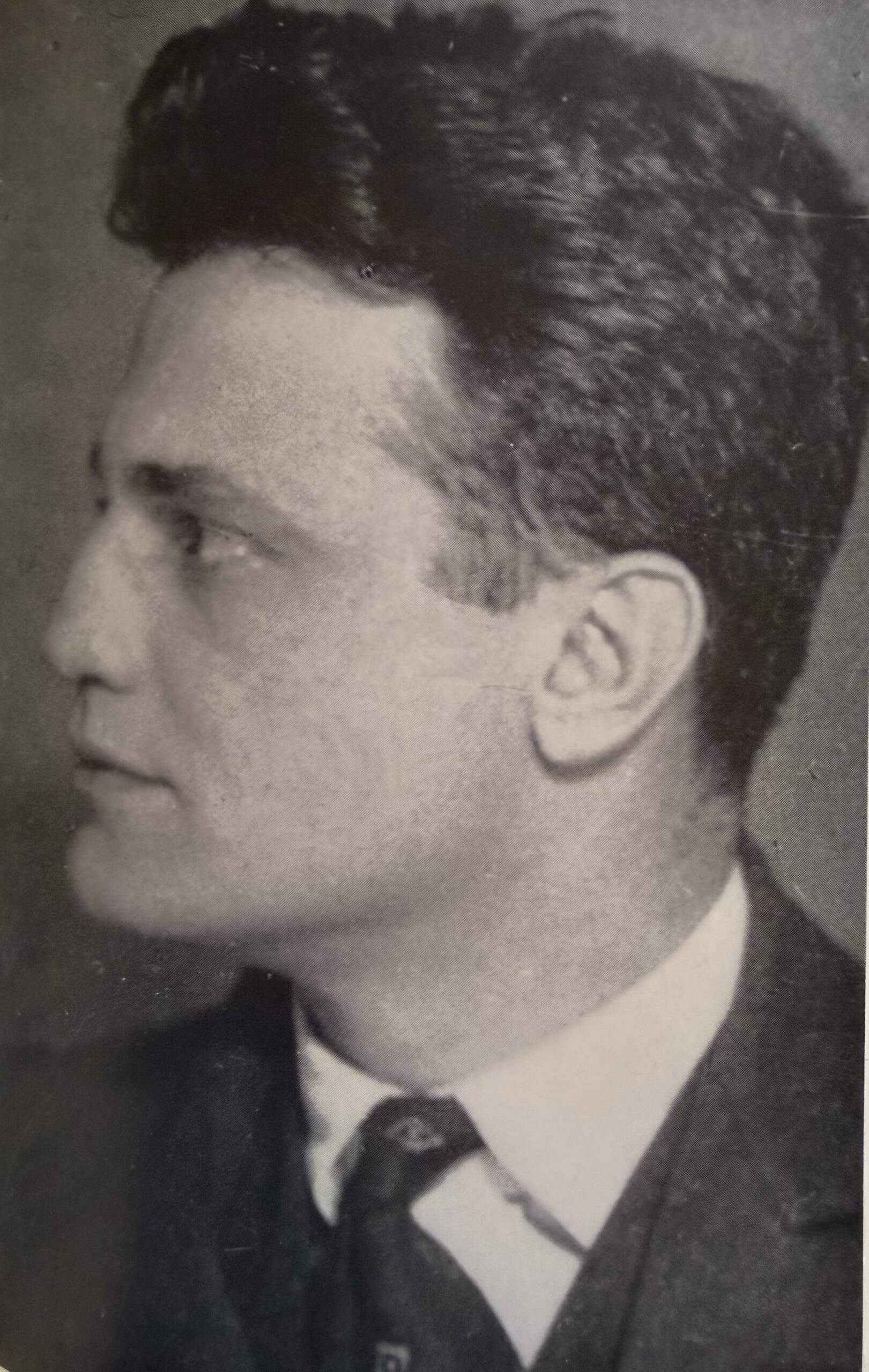
Harold Loeb. Photo credit: “The Way It Was,” a memoir by Harold Loeb.
Aside from his Judaism and non-service, there’s another unique aspect to Cohn separating him from the others. He is the only major character in this novel with children. It is ironic that this character, who has three children in a novel in which the family unit is conspicuously absent, sulks, pouts and behaves so childishly. The matter of Cohn and his kids is a mystery. He has apparently left them with their mother and gone off to live his own life. We never hear him talk about the children. We never know if they matter to him or if he has contact with them, but the impression is that he is an absent parent. We might consider him a puer aeternus in Jungian psychology–the eternal boy. His repeated visits to barber shops remind me of a teenage boy spending excessive time grooming himself to impress the girls. Robert seems to be expecting a grand romantic reunion with Brett when she arrives. His retreat from parental responsibility, his seeking validation from women and his general irresponsibility make him a far too familiar modern figure: the man who hasn’t grown up, a Peter Pan afloat in the world. Cohn’s mistress Frances, no prize herself, has grown tired of his drifting unreliability. The other characters sense this aspect of him and expect him to stand on his own two feet. At one point Jake firmly emphasizes that Cohn was expected to be able to deal with the Spanish himself: “we would not interpret for him.” To them, Cohn is a man-child.Cohn is drowning in Eros, in what Jungians call his anima, his inner feminine. He wallows in his emotions and lacks perspective. He is also ungrounded. Early in the novel, Barnes notes that Cohn’s literary success made him “less pleasant.” Cohn has become more arrogant and self-important. He floats through life.
There are positive aspects of Cohn. He is a successful author also skilled enough at playing bridge that he makes money at it. He is attractive to women. He is connected to his emotions; he is sensitive, sometimes moved by the world around him. He wants connection with others, especially Jake. He demonstrates kindness, at one point saving Jake’s seat on the bus to Burguete. He drinks, but he doesn’t seem to be numbing himself the way others are. One of the best things about Robert is that he sees the potential in life, while the others seem focused just on surviving. Early in the book he talks to Barnes about seizing the day, about life passing them by. There is some vision in Cohn, the feeling that he wants something more while these others are lost in a fog of booze and ceaseless motion. And while Cohn can be annoying–apparently Harold Loeb’s behavior at times could be much like his fictional counterpart–most of us are troubled by the harassment he encounters for being Jewish. The distinguished literary critic Harold Bloom felt that the antisemitism Cohn endures is a powerful indictment of the other characters and their emptiness.
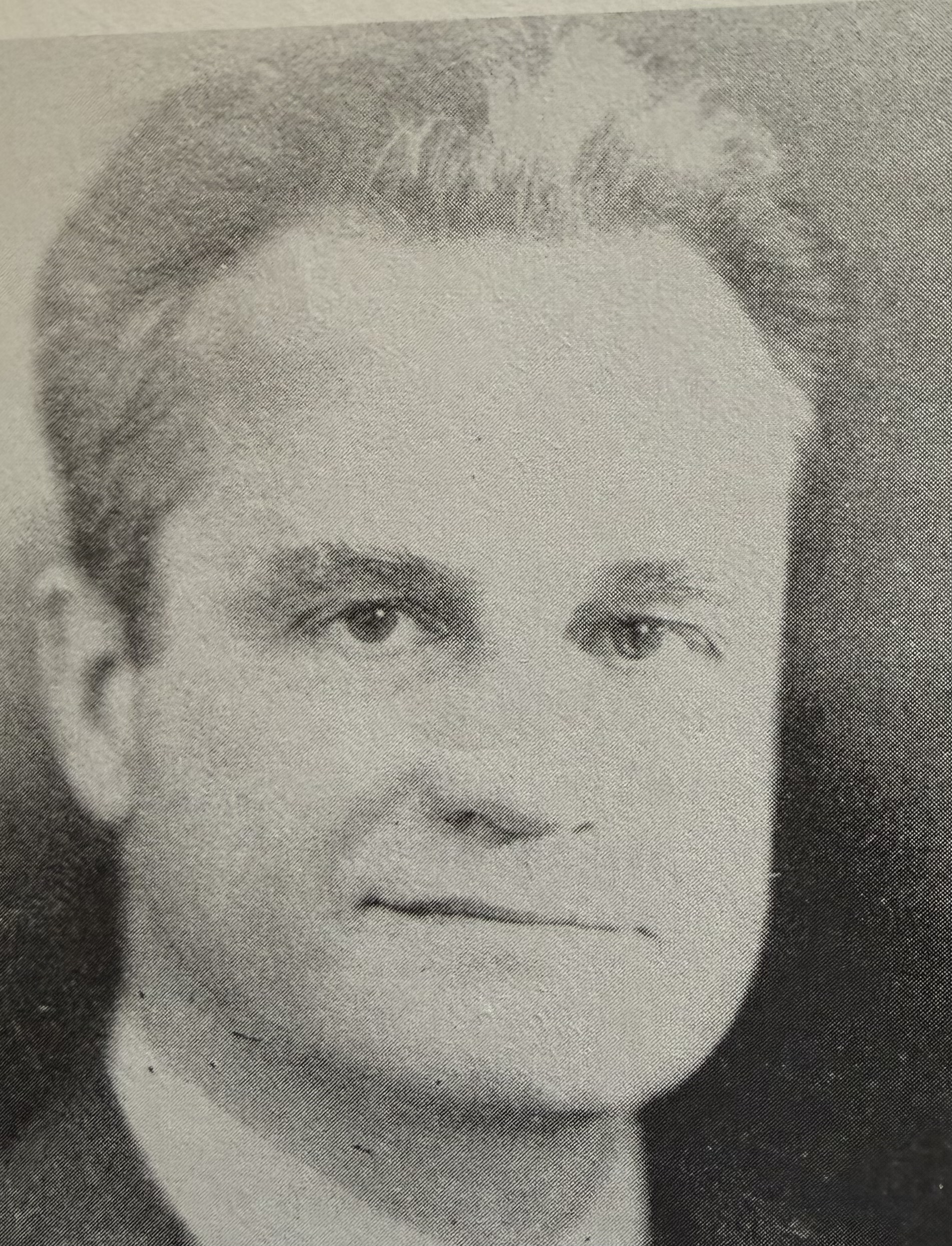
Harold Loeb
Finally, I suspect many modern readers would empathize with Cohn’s distaste for bullfighting. While the sport endures, opposition is strong and calls for permanent bans continue in Spain and other countries where the sport is legal. I can respect and appreciate Hemingway’s devotion to the sport, its rituals and heritage and its traditional role in Spain and other nations. Part of me is curious to see one; part of me would rather not. But I can see why Cohn dislikes it. However, it bears noting that in this novel this is another strike against Cohn, and it is part of a legitimate criticism. Like the self-absorbed man-child that he is, he is clueless about the deep layers of culture surrounding the fiesta and the bullfights. It is another mark of his obtuseness and failure to look at the hard realities of life and death as the other travelers have done and to appreciate the culture he is in, just as he fails to appreciate Paris.
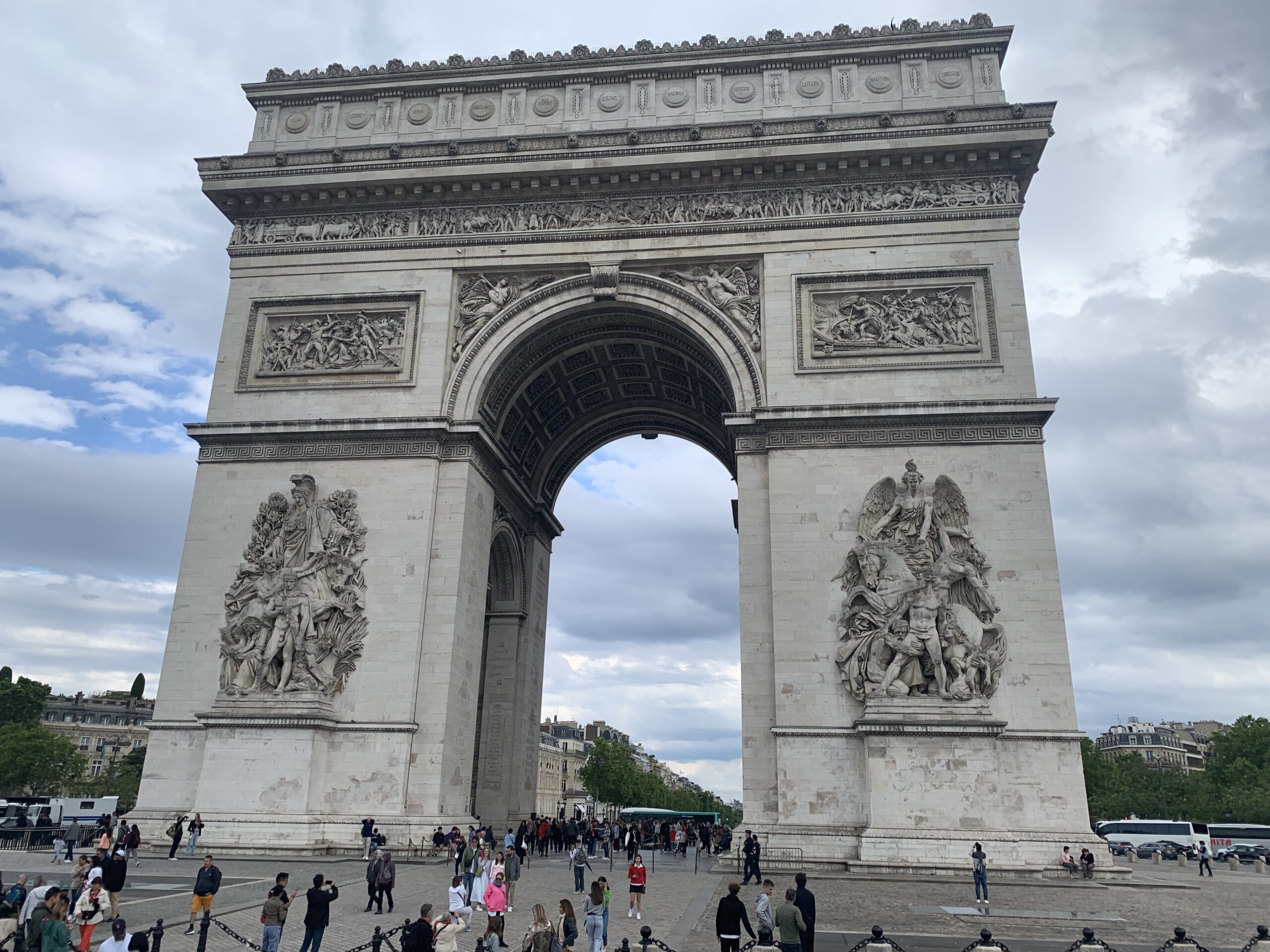
Arc de Triomphe, June of 2024 (author’s photo).
The problem is that he doesn’t have control over how he deals with these other characters or that he can’t adapt to the situations he’s in. There is a scene early in the novel when Cohn talks in his sleep in Jake’s office. He is saying, “I can’t do it. Nothing will make me do it.” Cohn is like a child having a nightmare, and Barnes the father working in his office while the child sleeps. His dream speech echoes Cohn’s traits of failing to adapt to the realities around him; he sounds like a small boy stamping his foot in refusal to comply. The business of Cohn sleeping reflects his Peter Pan status. Shocked by the hard facts of war, the other characters struggle with insomnia and restlessness–they are almost too aware. He floats away from reality into a literal dreamworld. He speaks to Barnes about the danger of missing out on life, but nods off on the car ride to Spain, missing the stunning scenery all around them.
A more mature man of his nature in this position would keep a careful distance from wounded people of this sort and even avoid them entirely. He would recognize the differences between himself and them and act accordingly. He would know when he’s not wanted and recognize the unfettered sexual aspect of Brett Ashley. He would not project anything on to her. He would recognize the damage to her spirit and that of the others. But that’s not the Cohn we have. He is a scapegoat for these people. They see their shadow sides in him: their own weakness and frailty, the illusions about life they once held, the sensitivity and vulnerability in themselves that frightens them.
Cohn is the wounded romantic who falls too far too fast. He can’t handle it when Brett pursues the nineteen year old Pedro Romero. He responds with intense violence against not only Romero, but Jake and Mike. It is an impotent gesture, the lashing out of a weak man who has no inner resources to confront the illusion he has fallen for and his own ignorance. He disgraces himself, losing all self-control and then weeping like a child and begging for forgiveness. Then he runs away. Cohn is the antithesis of the code hero, a refugee from an older world adrift in the realm of nada and postwar despair.
In the disillusioned modern world of The Sun Also Rises, Robert Cohn is the oddest man out.
JAKE BARNES
“I distrust all frank and simple people.”–Jake Barnes
Barnes is an expatriate, a journalist who runs his own news bureau in Paris, a man wounded in body and soul. He was an aviator in World War, flying on the “joke front” that was the war in Italy. Although never spelled out, Jake was likely one of the fifty pilots attached to the 332nd Infantry Regiment, the main American unit in Italy once the United States entered the war, a unit that included future New York Mayor Fiorello LaGuardia. Jake’s wound is never clearly described, although Barnes famously says “it was a rotten way to be wounded.” The general consensus of scholars is that Jake is missing his penis, or his penis has been damaged in some way that makes it unable for him to have an erection and ejaculate. He can experience sexual arousal, but cannot have sexual intercourse, which makes his love for Brett—and her love for him—all the more tortuous. The nature of Barnes’s wound intimately ties him to the realities of modern warfare. WWI saw the rise of a new kind of mechanized warfare in the form of tanks, planes, and submarines. Barnes has been injured in combat while operating a machine, giving him a visceral connection to the industrial nature of modern warfare.

Reproduction of World War One Liberty Loan poster on display at Ohio History Central in Columbus, Ohio (author’s photo).
Barnes has embraced the expatriate life. He is settled in Paris. He spends his days working, reading, playing tennis, visiting the bars and restaurants of the town and vacationing in Spain during the summer. His life choices reflect a broader pattern that is part of post WWI American history. After the First World War, a large number of American servicemen spent time studying in France at institutions like the Sorbonne before being discharged. Some chose to return or stay. They were among tens of thousands of Americans in Paris during the 1920s. Favorable exchange rates, the easy availability of alcohol–in sharp contrast to the philistine atmosphere of America’s Prohibition policy–and a more relaxed morality and variety of cultural stimulation made Paris in particular attractive not only for artists and writers, but Americans of independent means or other occupations.
Jake Barnes is a Midwesterner from Kansas City. We don’t learn much about his time there. Early in the book there is a scene where Jake is perusing his mail and opens a wedding announcement from back home. He has no idea who the couple are. There’s a sense of both geographical and emotional distance in this scene.
His inability to perform sexually is a deterrent to any marriage. At one point Jake asks if they could just be together, but she admits she would likely be unfaithful. The reader learns that Brett was a V.A.D. (Voluntary Aid Detachment) nurse during the war, that the soldier she loved died of dystentary and that she treated Jake in the hospital. The two fall in love with one another, but his wound is a barrier to intimacy. She eventually marries a British aristocrat, but the marriage is empty. Later in the novel we learn that her husband was deeply traumatized by the war as well. Brett turns to alcohol and sex to deal with her pain. The reader familiar with Hemingway’s biography will likely notice echoes of Brett and Jake in Hemingway’s short lived wartime romance with Agnes von Kurowsky, the American Red Cross nurse who treated him in Italy, an episode which formed a plot basis for his 1929 novel A Farewell To Arms.
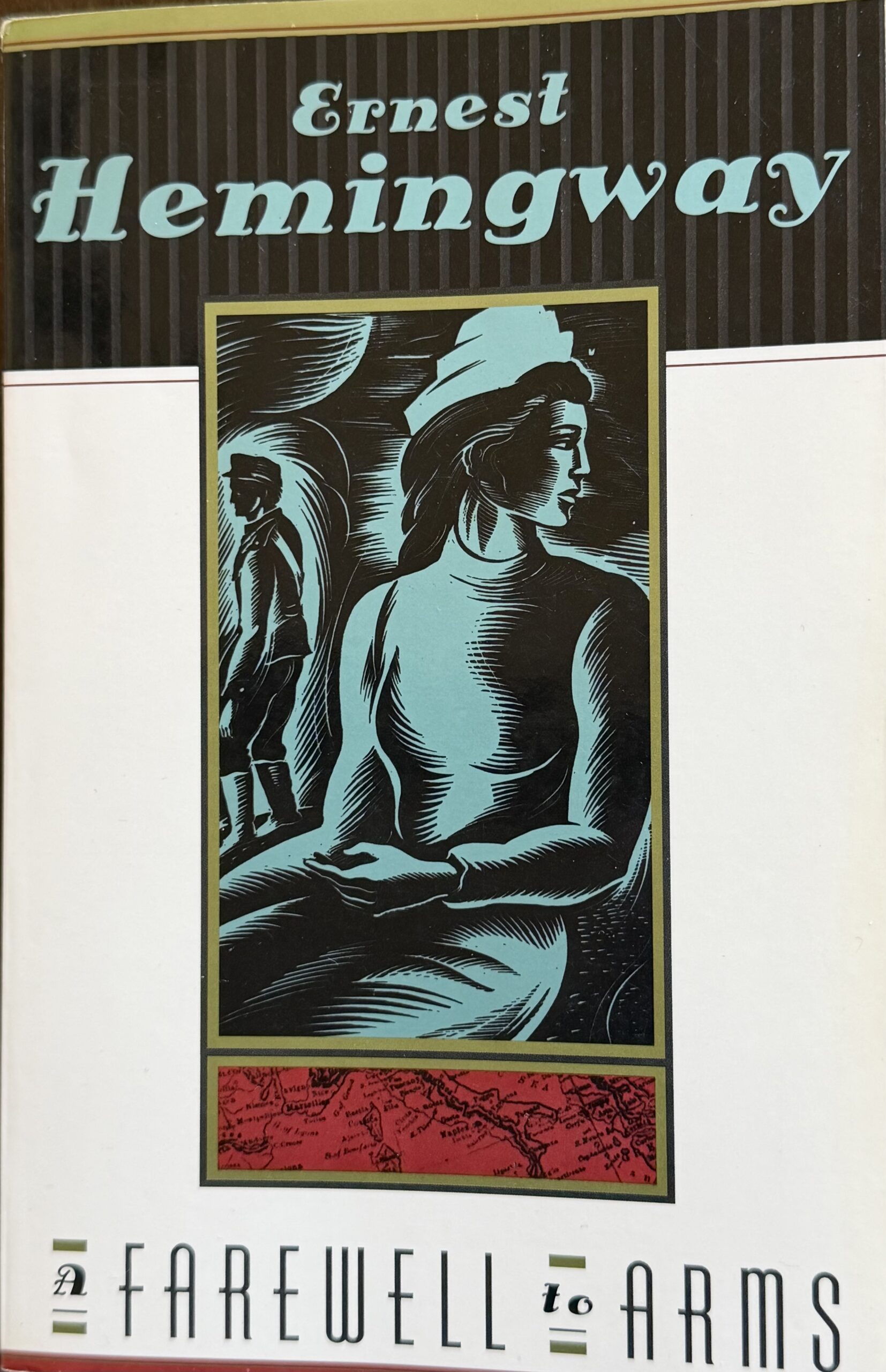
Author’s photo.
There are certainly echoes of Hemingway’s experience in Jake Barnes. Hemingway served in Italy during the war and was wounded, although he wasn’t a pilot. The issue of this type of terrible wound apparently hit close to home—no pun intended–as some pieces of shrapnel pierced his scrotum when he was wounded in Italy, and he heard of men who were wounded like Barnes. This was a rattling experience for a young man not long out of high school. The nature of this wound has a monstrous centrality in this book. As a man reading this novel, the issue of Barnes’s wounding strikes deep at a fear most men have, a fear especially worrisome for any young man. It’s a visceral, nerve rattling fear. It hits directly at the foundation of masculinity. For this reason I have a lot of empathy for Jake Barnes while also recognizing his flaws. Despite his alcoholism and depression, he’s a man full of life and vigor—he likes to fish, he relishes the countrysides of Spain and France, the delights of Paris, the beauty of women, the taste of a good meal and a strong drink. The life-urge is strong in him, despite his emotional struggles, and unlike so many of the other characters in this book, he works. He is a go-getter who started his own news agency after the war. He goes out on assignments. He is active. And he genuinely loves Brett Ashley.
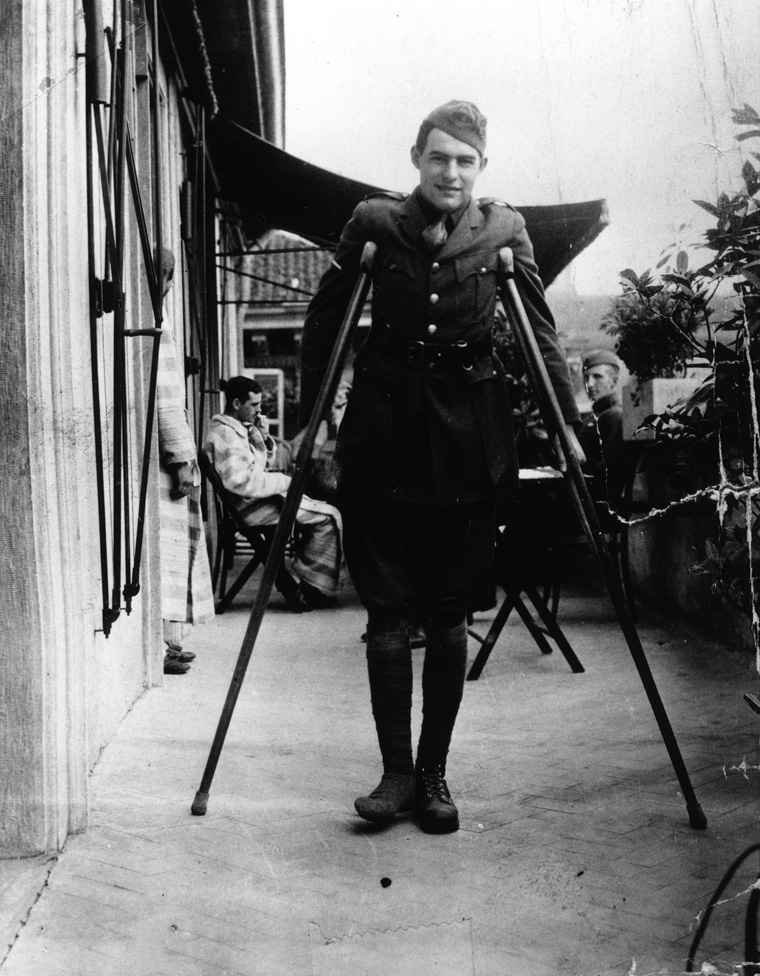
September 1918 Milan, Italy Ernest Hemingway, American Red Cross volunteer, recuperates from wounds at ARC Hospital. Milan, Italy. Image source: “Ernest Hemingway Photograph Collection/John Fitzgerald Kennedy Library, Boston.”
Barnes is a descendant of American literature’s frontiersman and adventurers. He carries with him a powerful sense of competence. He has survived war. He was a pilot flying one of those rickety biplanes of the First World War. He is a man who can negotiate forests and rivers and also operate in the modern city of Paris. As Barnes narrates this book, we realize that this is a man who knows the city, who can navigate its different settings. He has the makings of a Hemingway code hero: he does his level best to bear up under his pain, to accept his lot with stoic dignity. He has served honorably in war. He avoids public displays of emotion and steers clear of self pity. He has a great respect for craft, for doing things well and with integrity. This is reflected in the respect Montoya and other Spaniards have for him, for the fact he possesses aficion, the perceptive near-mystical appreciation of bullfighting and the danger of the corrida. Jake Barnes has a gift for friendship, despite his behavior with Robert Cohn. Part of him likes Cohn. His connections with Bill and Wilson-Harris show his capacity for friendship, along with his interactions with men like Montoya, Harvey Stone and the Count. He has a robust appreciation for both city and rural scenes. Jake is “telling” the story, and Jake can describe places, people and experiences with clean, vivid detail.
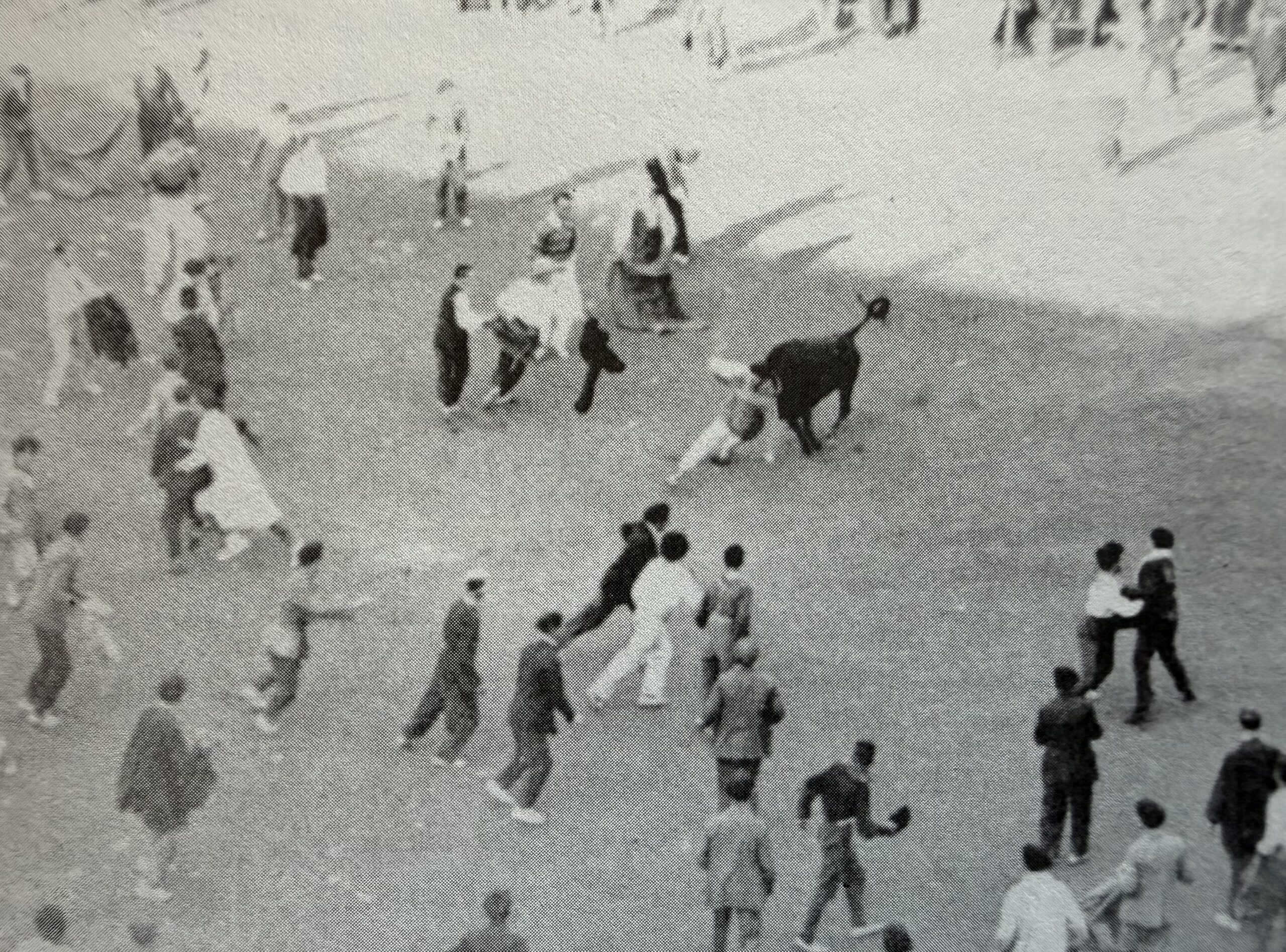
Harold Loeb had a brief moment of fame when he attended the bullfights in Hemingway, being lifted onto a bull. That’s him in the white pants at center.
But he is also vulnerable, and tries to protect himself from the world. Like the other members of the Wounded Quaternity, he has serious problems. One problem is how he relates to Cohn. He likes to see Cohn suffer pain. He’s not necessarily the one inflicting it, but he gets some satisfaction in seeing it. He can’t get past the fact that a guy like Cohn has been with his old girlfriend. The fact that she keeps running after different men, including Cohn, should tell him something, but he’s not getting the message.
One of Jake’s biggest problems, simply put, is Brett Ashley—or I should say his inability to set boundaries with her. He is a man who has foregone women while still desiring them, but instead of cutting Brett loose, he allows himself to get pulled into her orbit and her problems. It is what we would now call a co-dependent relationship. He tolerates her intrusions, such as when she shows up early in the morning with the Count. He never confronts her or challenges her about her behavior. He never takes the initiative to bring the romance to a close. He rescues her financially at the end of the book after disgracing himself by facilitating Brett’s affair with Romero. It is this pandering–essentially becoming a pimp for Brett– that reveals how far Jake has fallen.
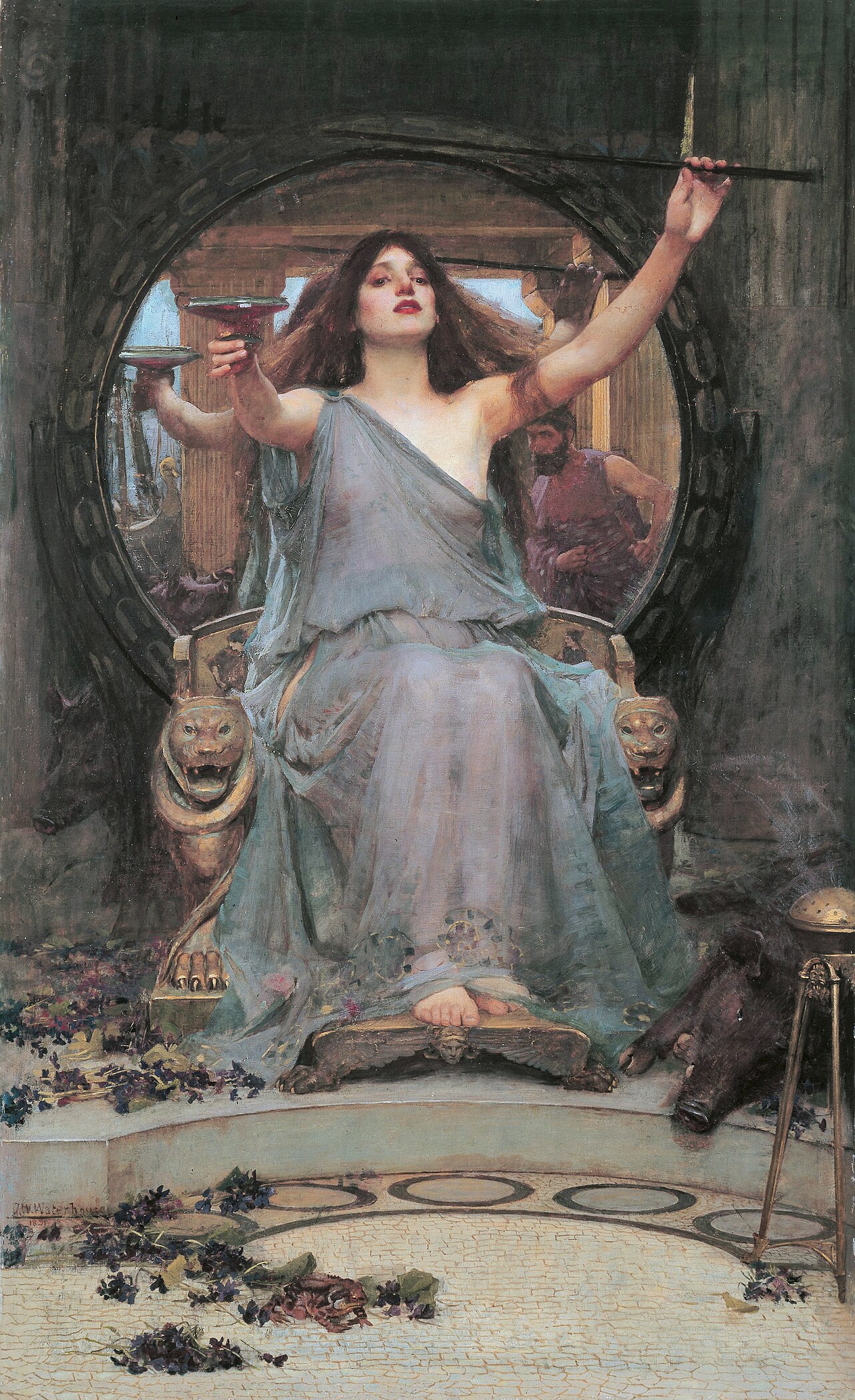
“Circe Offering The Cup to Ulysses” by John William Waterhouse (1891).
His pandering is especially ugly and a nasty self-betrayal as Jake is considered by Montoya and other Spaniards to possess “aficion.” This is a near mystical understanding of bullfighting and its rituals that goes beyond mere appreciation. It is a nuanced and deeply perceptive engagement with the craft and history of the bull ring. It is very rare for an American to have aficion and be accepted by the Spanish men, and Jake values his status. His betrayal of Montoya and the bullfighting culture marks his nadir in the dramatic action of The Sun Also Rises. It puts him in the class of foreign exploiters, like the “American women who collects bullfighters” that Montoya references earlier in the novel.
Jake is also an alcoholic. He tries his best to enjoy his life and bear up, but the bottle and Brett are twinned compulsions that get the best of him.
There is a long established literary connection between the state of Jake Barnes and the Grail story of the Fisher King. In the Arthurian romance, the king has been rendered impotent by a wound and the land reflects his sterility. The king spends his days fishing, a calming and centering act that gives his life a religious dimension. Eventually a knight visits the king and asks a question that heals his wound and restores the fertility of the kingdom. The parallels with Jake are clear. He is the wounded warrior, a young man of great promise deeply damaged by the Great War. The spiritual emptiness of the Lost Generation reflects the barren land. Like the king, Jake finds solace in nature and fishing in the Irati. But there will be no knight to come and help heal him. He will have to heal himself. In so doing, he will become the code hero.
BRETT ASHLEY
Brett Ashley is a great example of the “New Woman” in modern literature. Beginning in the late 1800s and early 1900s, the term “New Woman” was applied to women who lived more independent lives, and pursued higher education, careers, and involvement in the suffrage movement and other progressive causes. The flapper of the 1920s became the quintessential New Woman of the 1920s. Brett Ashley is certainly emancipated and modern. She embodies modernity.
She fascinates and charms the men around her. We have Hemingway’s famous description in Chapter 3:
“Brett was damned good looking. She wore a slipover jersey sweater and a tweed skirt, and her hair was brushed back like a boy’s. She started all that. She was built with curves like the hull of a racing yacht, and you missed none of it with that wool jersey.”
Brett is attractive and exerts power. She has a beguiling androgynous quality. Aside from her short hair, she is described at one point as bare legged–this from a time when women habitually wore stockings–and wearing a man’s fedora. Her short hair and adoption of mannish dress seem to have the effect of setting off her feminine attractiveness that much more. It’s not unlike a Rod Stewart or one of the 1980s glam metal musicians wearing feminine clothing while cultivating an aggressively heterosexual presence–the style of dress weirdly serves to highlight the male sexual identity more powerfully by contrast.
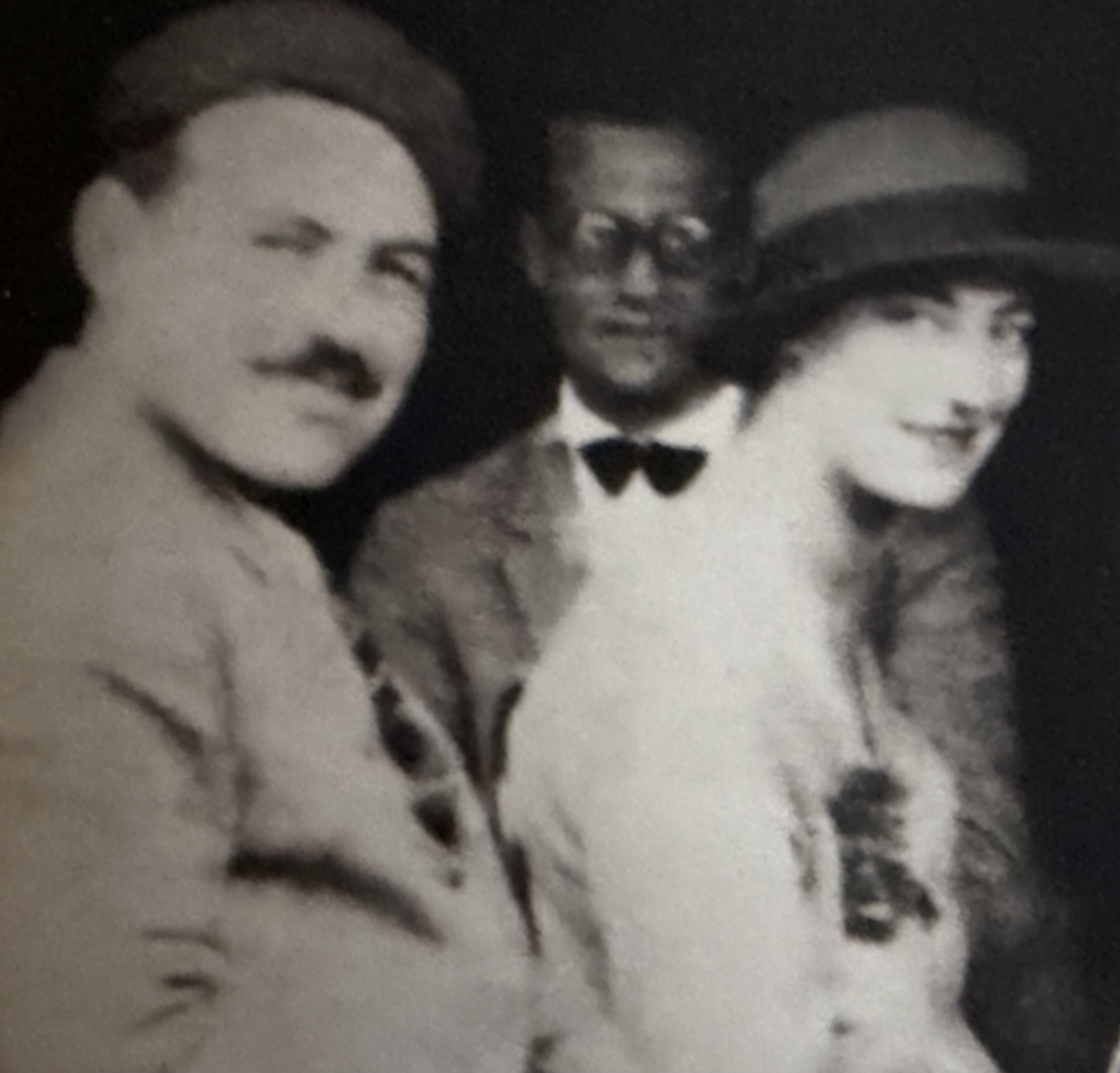
Detail of Hemingway, Loeb and Duff Twysden in Pamplona in 1925.
The comment about her hair is noteworthy. Brett’s hair is very short in the style known as an “Eton crop,” much in the manner of a man’s haircut. Josephine Baker was one of the first well known women to sport the style and Lady Duff Twysden, the model for Brett Ashley, stood out in her Paris circles for her Eton crop. But what is striking is how life would go on to imitate art, as if Hemingway was creating a little bit of the future: young women in America would be taken with the figure of Brett Ashley in his novel, and some would imitate her look, so the comment “she started all that” is striking.
Brett is associated early on with the relaxed sexual morality of the postwar world. When we first encounter her in Paris, she arrives in a taxicab with a group of young gay men she later dances with in the bar. Two of the defining qualities of the early modern era and Modernism itself were speed and motion. Brett is constantly on the go, running about from bar to restaurant to bar. A number of her scenes with Jake occur in taxicabs moving across Paris.
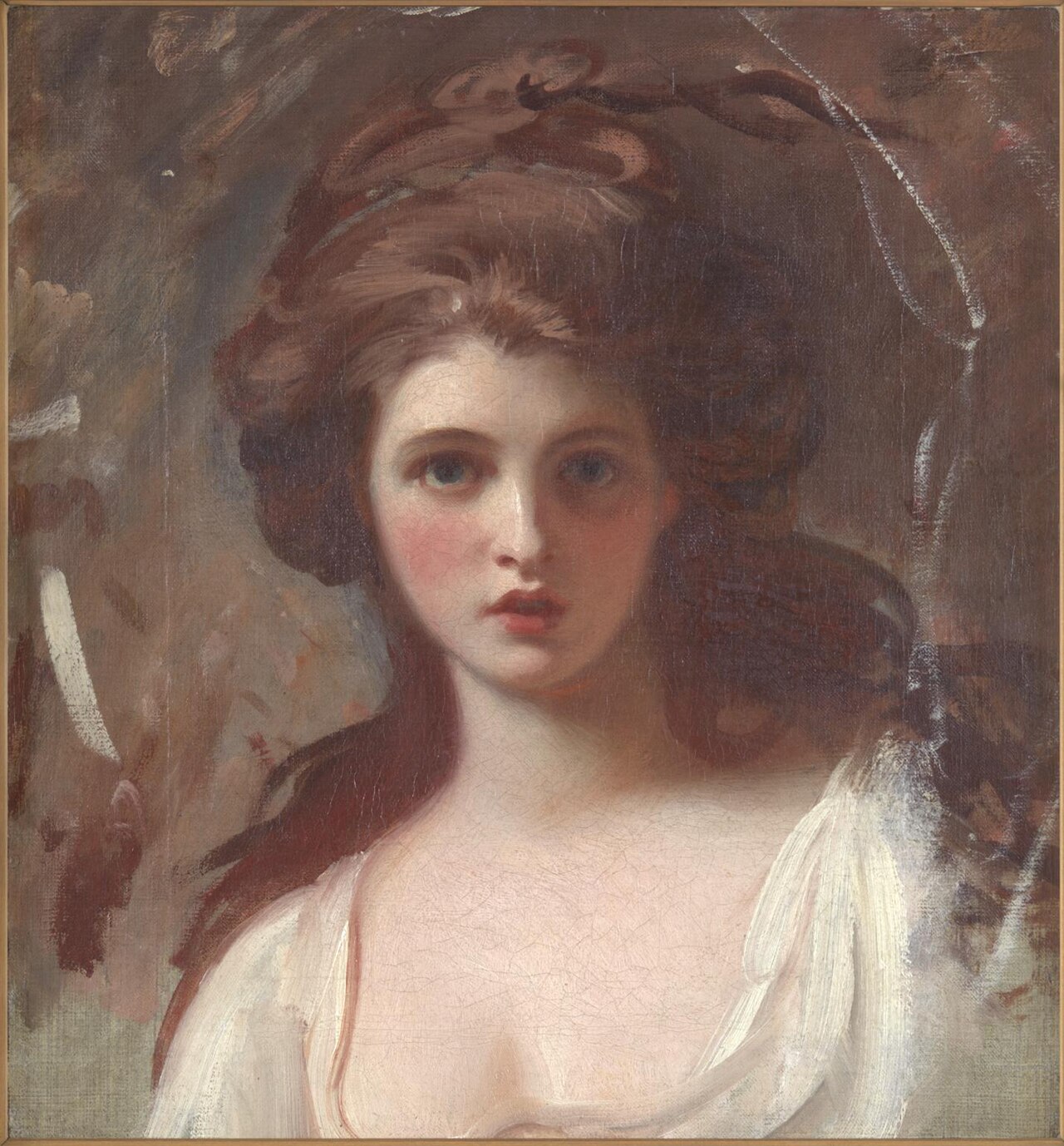
Portrait of Emma Hamilton as Circe by George Romney, around 1782.
Her breezy charm easily collapses when she is alone with Jake, telling him, in a dramatic conclusion to an early chapter, that she is “miserable.”
Robert Cohn is smitten with Brett when he first meets her. He queries Jake Barnes about her later on. Barnes is direct about an unpleasant reality of Brett’s–he tells Robert flatly that Brett is “a drunk” after Robert says she has “a certain fineness”–which she does. The Count tells Jake that she is charming “drunk or sober.”
Literary criticism changed with the rise of the women’s movement as more female scholars addressed Hemingway’s works. There was more appreciation for Brett as a woman who operated on her own terms and made her own choices about how she lived and how she used her body. She was asserting the kind of sexual freedom a lot of men had enjoyed. Brett is a complex character and deserved more nuanced examination. It was a long overdue corrective.
However, we can appreciate Brett’s independence, charm and colorful personality while still recognizing the problems that bedevil her. She is one member of the troubled quaternity in this book, all of them caught in dysfunctional patterns resulting from wartime trauma.
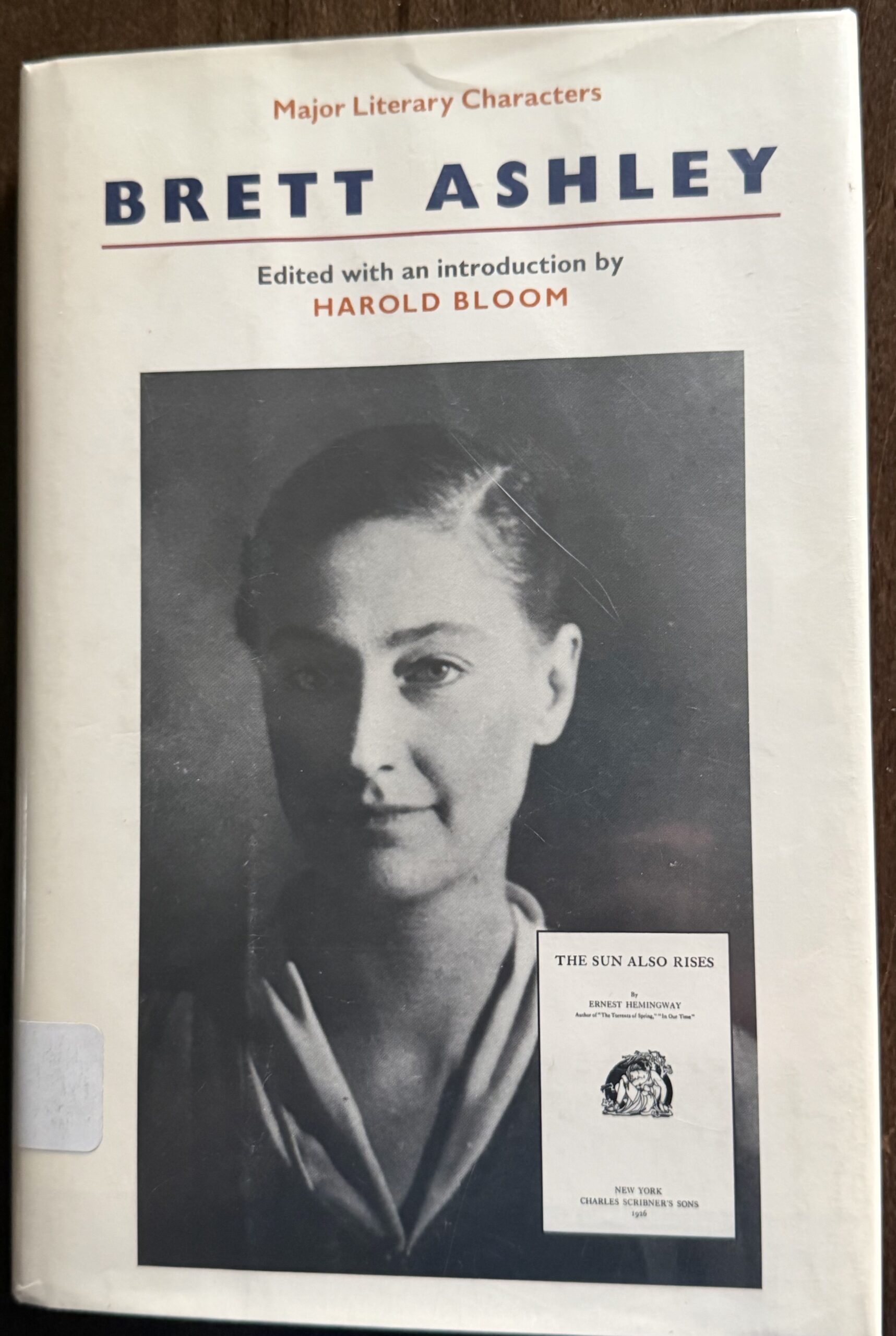
Lady Duff Twysden’s photo appears on the cover of the Brett Ashley volume of the Major Literary Characters series of books published by Chelsea House: a rare example of a photo of a real person being used on a book about a fictional character.
Brett is a badly damaged woman. During the Great War she served as a V.A.D. (Volunteer Aid Detachment) nurse. These were volunteer civilian nurses, many without medical training, who assisted with practical nursing tasks during the war. They served in hospitals back in the United Kingdom and near the front lines. It’s worth considering what her work likely entailed–tending to young men torn apart by shells and high velocity bullets, men who were gassed or who had wounds accompanied by severe shell shock. The man she loved died of dysentery in the war. Following the war she married a British nobleman who kept a pistol under her pillow and abused her to the point she would sleep on the floor instead of getting in bed with him She and Jake Barnes fell deeply in love when he was under her care, but he is unable to fulfill the physical aspect of a romantic and sexual relationship. Like Jake Barnes, she turns to alcohol to numb the pain.

Drawing of Duff Twysden by Harold Loeb from his book “The Way It Was.” I can’t help but think he captures some of her spirit here.
But like other damaged people, her behavior hurts others. There is no center to her life. She drifts along with Mike Campbell, another alcoholic war veteran who lives a purposeless existence. At one point Pedro Romero, the young bullfighter, asks Jake about Mike Campbell, saying “What does he do?” Jake Barnes replies “Nothing,” then Romero asks, “Is that why he drinks?” Rather than quit drinking, deciding to turn her life around and find some kind of constructive way to live, she has chosen to cast her lot with Campbell. They are both going nowhere. It is easier for her to take the path of least resistance and cast her lot with this man who has a guaranteed income and a desire to live adrift. They make a mess around them and then run off. For someone who is the emancipated New Woman, she relies too much on men.
She is frequently late and unreliable. She is also insensitive and self-absorbed, barging into Jake’s apartment early in the morning although he has to get up and work later. She takes advantage of the Count’s generosity. She uses the men around her. She deserts Mike for a while to run off with Cohn, who becomes obsessed with her, then returns to Mike while continuing to meet with and confide in Jake. Jake is a sounding board for her, someone she wants to keep close by, but she seems oblivious to how painful this must be for him–and he doesn’t assert himself like he should and set boundaries. She flaunts her desire for Romero in front of Mike and the others.
She is like the center of the wheel and the men are spokes turning in relation to her. Robert Cohn refers to her as Circe, the goddess who turned men into swine and who was resisted by Odysseus in The Odyssey. I find the analogy of Brett to Circe compelling. I don’t see her acting directly like Circe to reduce men to a swinish state–at least not consciously–she has a pattern of acting out revealed in sexual activity and drunkenness. But I do think Jake, Robert, and Mike respond to her as men affected by a Circean power they project on her. They all seem willing to lower themselves in some way for Brett: Mike tolerates her affairs, Robert hangs about like some pathetic puppy wanting her approval, and Jake is far too available to her as rescuer and sounding board. There is a double edge to all of this. In a better world, each man would give her the rejection she warrants. She seems to hold the anima for each man.
In Jungian psychology, the anima is the feminine component inside the male (the female’s inner masculine is called the animus). These are psychic structures inside people. It is the man’s anima that contains his capacity for connection, love and creativity. When a man falls in love, he projects his anima onto a woman. Eventually the projection fades, and if the couple are still drawn to and committed to one another, the real work of love begins. But a man in the grip of the anima obsession can behave exactly like Cohn and Barnes–either hanging on pathetically or trying to make something out of a connection that has already short circuited. While these men are responsible for their behavior, Brett Ashley doesn’t do much to address her role in these things. She chases after Barnes, tolerates Cohn, despite his irritating presence, and cuckolds Mike.
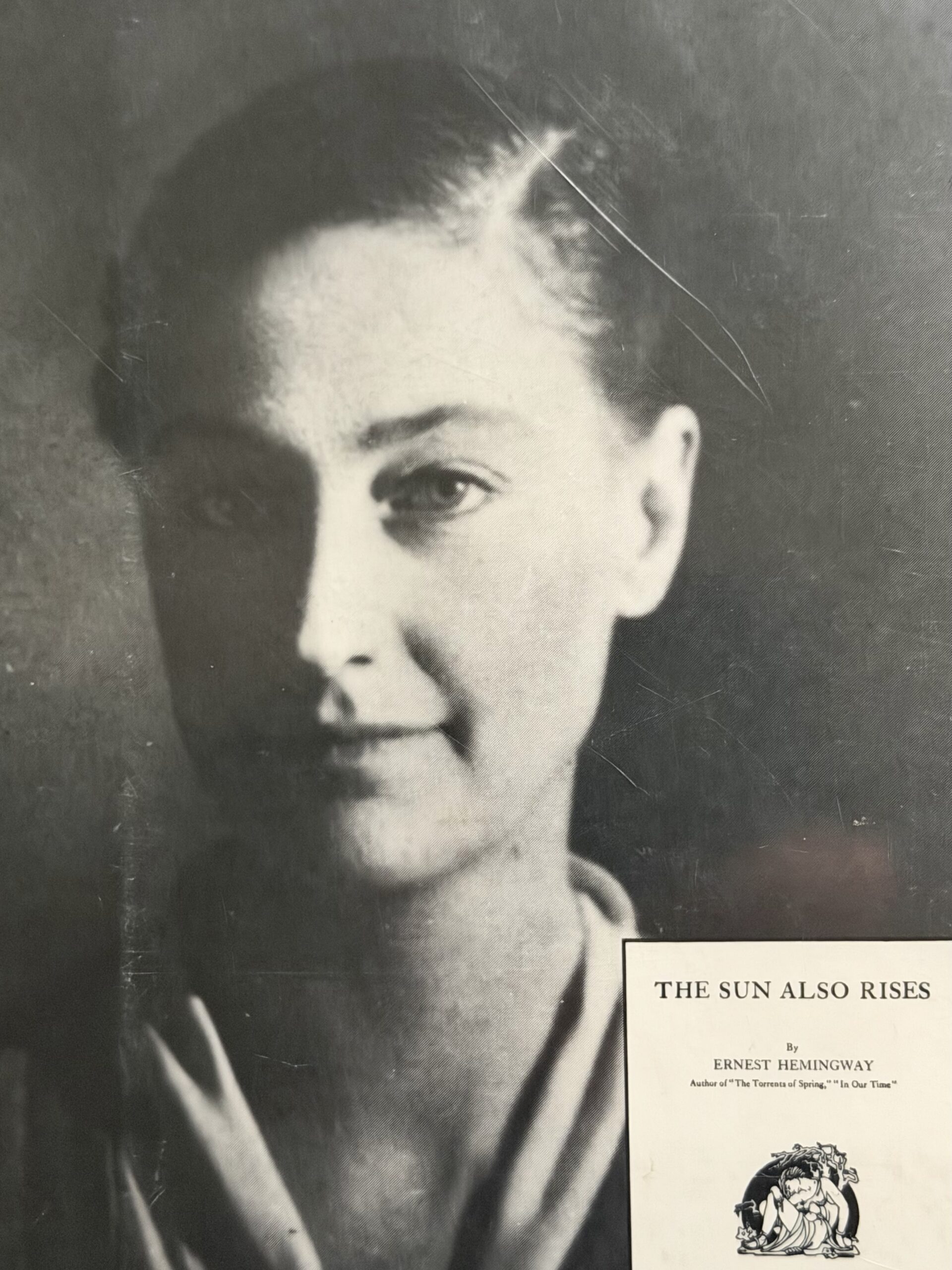
Detail of Lady Duff Twysden from the book cover pictured above.
Her worst sin is her behavior with Pedro Romero, a sad undertaking aided and abetted by Jake Barnes. She acts in a totally selfish manner. This is where she seems out of control, in the grip of obsession, willing to go after someone nearly half her age—nineteen years old–and without any respect or consideration for the ancient Spanish bullfighting culture and San Fermin community he represents and serves. Pedro plays his role as well–he pursues her, sleeps with her and runs off with her, but she rejects him as he wants to marry her and see her dress traditionally and wear her hair longer. Finally, at the novel’s end, she seems to understand how destructive her behavior is. She sends Pedro away.
I find Brett to be a fascinating but exhausting character. The renowned scholar Harold Bloom thought Brett the liveliest character in the book. She has a powerful energy. Hemingway does a masterful job of rendering her sprightliness and appeal but also her ennui, her high maintenance self-absorption. I’m not the first reader to appreciate the period where she disappears from the book for a while as we travel with Jake, Bill and Robert into Spain and then accompany Jake and Bill to the village of Burguete, where they enjoy time with the English war veteran Harris–“good old Harris,” as Bill calls him. I found it good to get away from Paris and the bars and drinking and Brett’s perpetual drama.
And during the last two times I have read this book I found myself rolling my eyes in exasperation as Jake gets her telegram while he’s recovering in San Sebastián, the same place where Brett and Cohn had their tryst. Some of you reading this post have likely dealt with a needy person always coming to you for help or wanting to be rescued. It may be a family member, or maybe we have worked in social service or customer service and have had someone glom onto us and want us to handle something they need to handle themselves. In this last segment of the book, that tiresome needy person is Lady Brett Ashley–and her problems are severe.
There’s a simple but powerful example of Hemingway’s craft illustrating the famous writing concept of “Show, don’t tell” in the last section of the book. When Jake gets to her hotel room in Madrid, he describes the interior. It is a mess, with clothes strewn about and the room in disorder. But one of the most damning details is this: the bull’s ear Romero gave her–a great honor from a bullfighter–is stuffed in a drawer along with cigarette butts. This description speaks volumes about Brett’s life, about how she has interfered in the bullfighting culture of San Fermin, but there is also a poignant detail illuminating the deep conflict inside her–the bull’s horn is wrapped inside a handkerchief belonging to Jake Barnes.
MIKE CAMPBELL
Mike Campbell is arguably the character most readers feel the least sympathy for. He is a Scottish World War I combat veteran, a bankrupt who lives on money sent to him by his mother. He allows himself to be repeatedly cuckolded by Brett Ashley. Like Brett and Mike, he devours huge quantities of alcohol. He frequently baits Cohn throughout the novel. One of the worst indictments of Mike appears when he relates the story of the medals. Mike is apparently saw a lot of combat in World War 1. He says “I suppose I’ve the usual medals. But I never sent in for them.”
He relates that he was invited to a dinner the Prince of Wales is attending and attendees should wear their medals. He goes to his tailor and borrows some medals there belonging to another client. He ends up giving them away as souvenirs to girls at the event. He dodges the tailor about them when the other man requests his medals, which had been sent to the tailor to be cleaned. He pays the tailor a hundred pounds a year to keep quiet, which he does until he becomes bankrupt.
This callous treatment of another veteran is troubling behavior and indicates serious character flaws in the man. Mike can be charming. He has a lighthearted, breezy kind of manner earlier in the book not unlike Brett’s, but he becomes increasingly nasty as the book goes on, especially when he baits Cohn—and Brett repeatedly tells him to quit. He seems the most lost of all these characters and the most unlikely to ever find any redemption. Nevertheless, Bill and Jake get along with him, and Bill in particular, who is probably the most easygoing of this lot, enjoys Mike’s company. Mike also has a great line in the book. When he is asked how he became bankrupt, he responds “Gradually and then suddenly.” This strikes me as an apt description of how bad habits or vices build and then suddenly sink us.
JAKE AND ROBERT: THE DOUBLING OF BARNES AND COHN:
There are similarities between Jake Barnes and Robert Cohn, enough so that some literary critics have talked about them being “doubled.” There are similarities between the two men, the most prominent being their mutual desire for Brett Ashley. Both men are writers and both played football. Jake Barnes knocks Cohn for his interest in W.H. Hudson’s The Purple Land, but later on the Irati River he takes a break from fishing to read a book by A.E.W. Mason, an English author of romantic novels. The book in question is a mountaineering adventure story called, appropriately enough for where Jake’s reading, Running Water. Barnes excoriates Cohn for his romanticism, but Barnes has to shed his own romanticism—the idea of having a connection with Brett that is truly meaningful in the romantic-erotic–matrimonial sense. In chapter 15, Barnes falls asleep in one of the beds in Cohn’s room and then puts on one of Cohn’s coats before going out onto the balcony to see the bulls race through the streets. At one point Brett refers to him as “Jacob” and says “You’ve a hell of a Biblical name, Jake,” referencing the grandson of Abraham in the Old Testament.
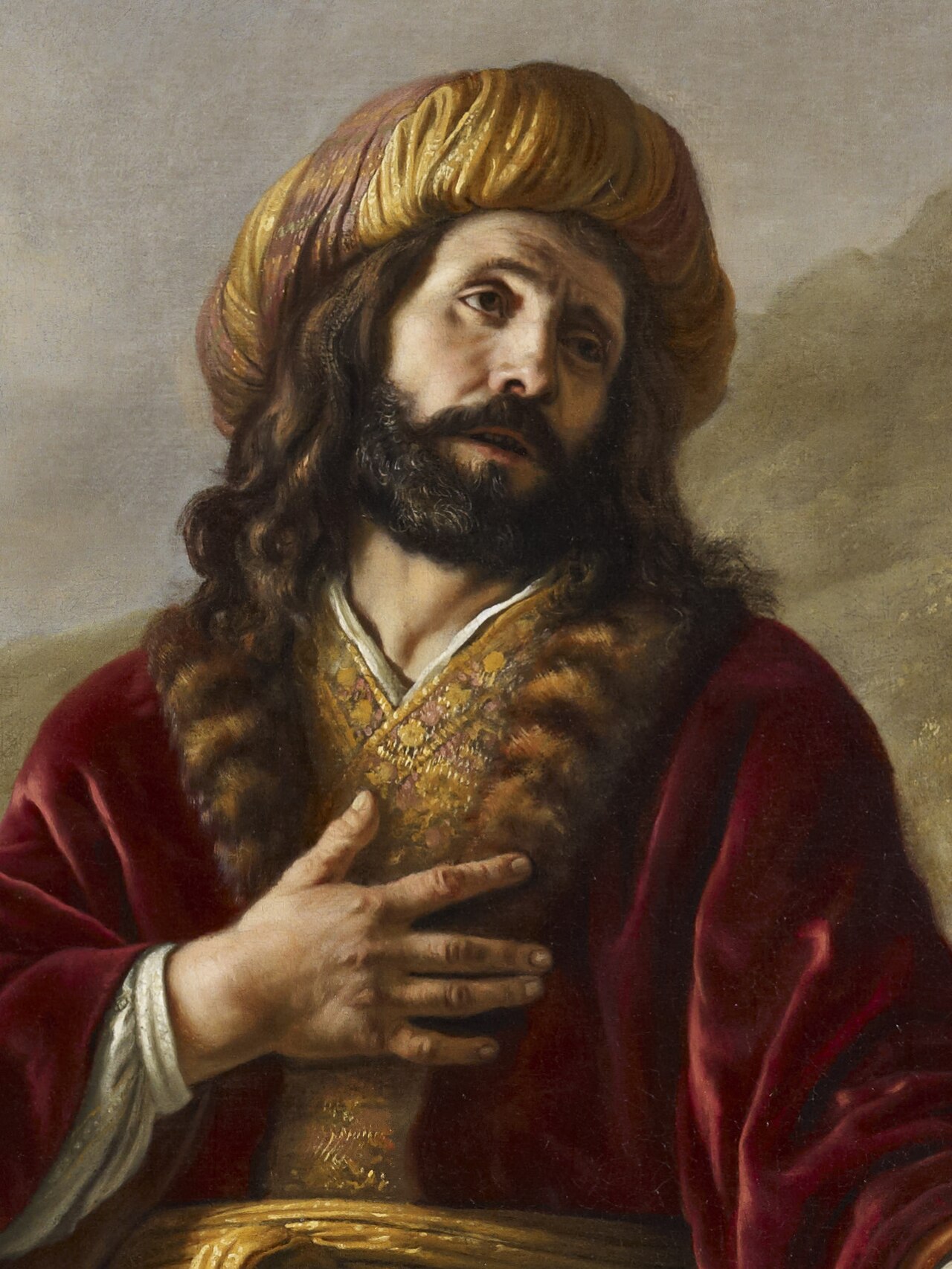
Jacob from the Old Testament.
There’s an especially close connection between the two men towards the end of the fiesta. Barnes has been slugged by Cohn, and while walking back up to his room he remembers coming home from a football game in autumn. He feels like he is carrying a suitcase with his football gear in it. He goes up to Cohn’s room because Cohn wants to apologize to him. Cohn is wearing a white polo shirt, echoing his college boy days at Princeton. Both of them are beaten. Jake has been literally pummeled—Mike notes that he was knocked out cold–and he has brutalized his own spirit by pandering Brett to Pedro, an effort to please her and get back at Cohn. Cohn has reacted with violence and lost control. These ghosts of schoolboys are bound together with the vicious psychic wounds they have inflicted on themselves.
EXPATRIATION AND THE 1920s:
The Sun Also Rises is a novel that features a mix of American, British, Scottish, French and Spanish characters in Spain and France. It is one of the first major American novels after WWI that features Americans living abroad. Expatriation is a significant topic in American literary and cultural history. The complicated relationship between early American writers and artists and their European cultural inheritance was a source of tension and recurring topic after the Revolution. The artists, writers and intellectuals of early America were mostly white men of European background. Europe, particularly England, was the homeland of their ancestors. Their cultural ancestry was grounded in England and western Europe, a tradition that included the great sweep of western culture reaching back to the Greeks and Romans and the Judaeo-Christian heritage of the Bible.
In the breakaway from England, young artists and intellectuals wanted to create a new literature that drew on American themes, settings and ideas. Much of canonical American literature of the 1800s and early 1900s dealt with the fact of America. Hawthorne explored its Puritan past. Whitman celebrated America in poetry. Novelists like James Fenimore Cooper and Mark Twain explored the meaning of its frontier and raw wilderness. Melville’s settings ranged beyond the United States, but his Europe was more the rough streets of Liverpool in a work like Redburn, and some of his foreign locations were a frontier of their own, like the South Sea islands of Typee and Omoo. Melville was fascinated by the soul of America and the darkness hidden in the democratic experiment that is the United States. Ralph Waldo Emerson and Henry David Thoreau were well educated men deeply schooled in the classics, but both worked to formulate philosophies that were deeply and originally American. Works by Frederick Douglass and Harriet Beecher Stowe confronted diseased American race relations and the problem of slavery.

Ralph Waldo Emerson
But the influence of Europe was always there. American artists continued to travel abroad to study. James Fenimore Cooper, who explored the American forest, frontiersmen and Indians in the Leatherstocking novels, spent seven years living in France. Jefferson and John Adams were deeply influenced by their time in France. Nathaniel Hawthorne was U.S. consul in Liverpool –this from a time when an American intellectual or writer could be appointed to a post in the U.S. foreign service. W.D. Howells of Ohio, along with Henry Adams, was in Europe during the Civil War in a diplomatic post.

Mark Twain in his later years.
Europe later became a residence for American writers. Henry James decamped for Europe in 1875, and he is well known for his explorations of the American abroad. Other American writers and artists moved to Europe in the late 1800s and early 1900s–James McNeill Whistler, John Singer Sargent, Stephen Crane, Mary Cassatt. Twain spent nine years living overseas. We often forget that Twain spent considerable time researching and writing a novel about Joan of Arc that he thought some of his best work. One of those expatriates who landed in France during the early 1900s would play an important role in Hemingway’s life: Gertrude Stein. She arrived in France in 1903, just three years after Twain returned to America.
American travel to Europe increased during the early 20th century, part of a pattern of American society and culture becoming more present on the world stage. The country began emerging as a major player after the Spanish-American War in 1898. The American frontier was closed and the nation established a greater presence in areas outside the continental U.S. But while the country was becoming more industrialized, it was also largely rural, and many Americans didn’t look much further than the limits of their owns neighborhoods. They were busy trying to make a living in the rough and tumble nation of those decades. There would be a pattern of advance and retreat for the country through the first decades of the century when it came to engaging with the broader world.
One major change was the First World War, mobilizing tens of thousands of Americans into service, sending women into industrial jobs as they would again in WWII, and creating a more complex bureaucratic state.
Americans retreated from foreign affairs after the First World War, many sharing Warren Harding’s desire for “normalcy” after the years of war, rationing, influenza and the paranoia that was the Red Scare. The desire was understandable. The country’s focus had been on building and developing itself and managing its own problems during the 19th century. Involvement in the Great War was a shock to the system. I believe that many of us also have a greater appreciation for the effect of the flu epidemic on the people of that time after our experience with Covid-19. Americans actually had it far easier than European nations , but they were tired of Woodrow Wilson and Europe’s problems. But America was more deeply bound to the world beyond its shores.

President Woodrow Wilson
The world would intrude on Americans in the years ahead in ways they never expected, especially when another war broke out, and from that point on America would need to deal with the fact of Europe, would be bound more deeply to Europe and other nations than it had before and would be the world’s leading democracy. Many a young American man—and later, increasing numbers of women– would find themselves stationed overseas in Germany, England, Japan or Korea in the post WWII years. The world became smaller through the century as countries becoming more interconnected, travel times shortened, and cultural exchange programs were established. Modern media relayed news of events around the world not long after they happened or later live through satellite technology.
America’s expatriates in 1920s France were a counterforce to the isolationist tendency taking deeper hold in the U.S. The story of expatriates is that of a counter movement against this trend towards isolationism. Hundreds of thousands of Americans were in Paris at any given time in the 1920s, and thousands of Americans were residing in the city. They weren’t just artists and writers. They included wealthy businessmen and industrialists, journalists, and Americans working overseas in everyday kinds of jobs.
Jake Barnes, as noted earlier, is truly a settled expatriate. Paris is his home. He has an apartment. Brett and her fiancé Mike Campbell are expatriates who wander from one place to another, sometimes moving on because they have run up debts and are being bailed out by one person or another. They seem to have left the United Kingdom for the time being. Count Mippipopolous is also an expat. Cohn, his girlfriend Frances and Bill Gorton seem more like long term travelers in Europe. When we meet Gorton, he refers not only to his travels in Europe but also recent time in New York. We learn early in the novel from Jake Barnes that Robert Cohn was over in Europe, then returned to New York and is now back in Paris.

View of Paris from the middle level of the Eiffel Tower: June, 2024 (author’s photo).
Expatriation as a force transforming Paris is explored early in the book, including establishments appealing specifically to Americans. Not long after Bill arrives, he and Jake go eat at Madame Lecompte’s. Jake notes it “was crowded with Americans and we had to stand up and wait for a place.” Madame Lecompte’s has experienced the fate that happens to some destinations–it merited attention in a publication as a “quaint restaurant on the Paris quais as yet untouched by Americans, so we had to wait forty-five minutes for a table.” Madame LeCompte makes “a great fuss” over seeing Bill for the first time since the Armistice, but Bill notes that it “Doesn’t get us a table, though.” Business is business in France. They eat a good traditional American meal featuring items such as apple pie, mashed potatoes, roast chicken and green beans. Madame LeCompte asks Jake why he doesn’t come around and he says “too many compatriots” in reference to fellow Americans.
There was criticism of expatriation in the 1920s. Some other writers felt that the expats were losing touch with their native ground. Bill Gorton jokingly accuses Jake Barnes of this when they are fishing on the Irati.
“You’re an expatriate. You’ve lost touch with the soil. You get precious. Fake European standards have ruined you. You drink yourself to death. You become obsessed by sex. You spend all your time talking, not working. You’re an expatriate, see? You hang around cafes.” The joking continues, with Bill claiming that “one group claims women support you. Another group claims you’re impotent.”
There’s some awkwardness about this as Bill realized he has stumbled on difficult territory, but Jake recognizes his discomfort and plays along. Bill pivots into this strained moment with a reference that likely puzzled readers then and would merit a footnote now. Bill mentions “Henry’s bicycle” as a cause of impotence, actually referencing the American writer Henry James, who wrote about an “obscure hurt” incurred while fighting a fire that prevented him from having sexual relations. There was a rumor that James had been castrated or sexually injured while reading a bicycle. There was likely no wound. James was most likely a deeply closeted and celibate gay man. The irony here is that James is the expat writer par excellence, one who actually became a British subject shortly before the end of his life.

Henry James
America’s presence looms large in their talk during this time on the river. The men talk in joking fashion about a number of prominent Americans. Two of them are public figures associated with the reactionary forces spurring Americans to flee to Europe. We learn William Jennings Bryan of Nebraska has died. Bryan served as the Democratic Party nominee in the 1896, 1900 and 1908 elections and later served as Woodrow Wilson’s Secretary of State. Dubbed “The Great Commoner” and “The Boy Orator of the Platte,” Bryan was born in Illinois and later moved to Nebraska. Early in his career he was known as a progressive force in politics, supporting western farmers against moneyed interests in the eastern U.S. opposing American imperialism. Later he became involved in Prohibition and opposition to Darwinism and was the prosecuting attorney in the Scopes Trial.
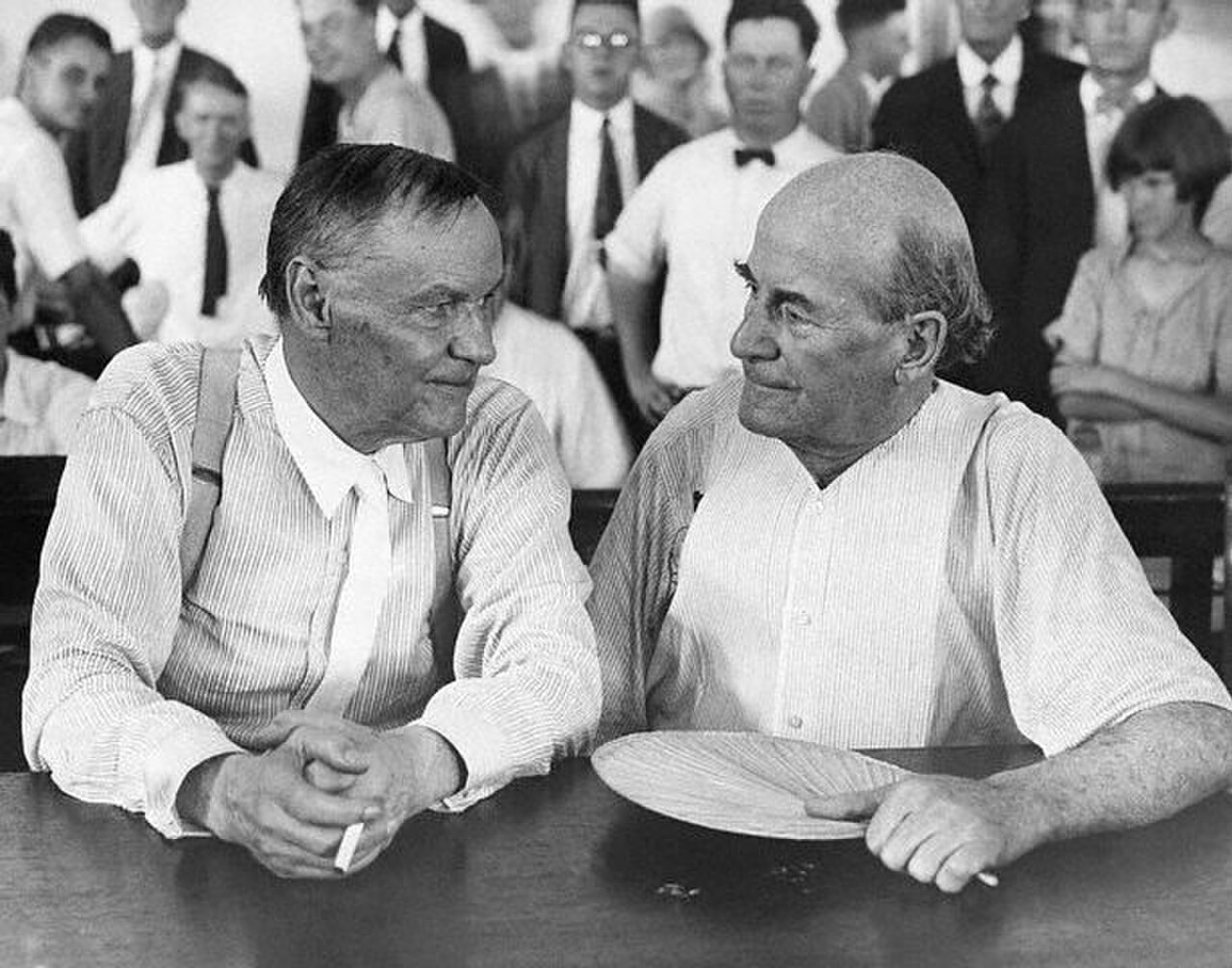
Two legendary Midwesterners: Clarence Darrow of Illinois and William Jennings Bryan of Nebraska during the legendary Scopes Trial during the summer of 1925.

William Jennings Bryan
Another figure mentioned is Wayne Wheeler, an Ohio native, attorney, and leader of the Anti Saloon League, an organization that pressured politicians on Prohibition and was a leading force to implement Prohibition in the United States. Wheeler was a brutal zealot willing to use intimidation and blackmail to reach his ends and even formed an alliance with the Ku Klux Klan in support of Prohibition. Other Americans joked about include Frankie Frisch, a standout baseball player with the New York Giants at the time of this novel, and Bishop Manning, a conservative Anglo-American Episcopalian clergyman.

Frankie Frisch during his time with the New York Giants.
This discussion occurs not long after Bill and Jake have had an encounter with a former expat of a different kind. When they travel to Burguete, they are seated near an older Basque man who spent fifteen years in the United States. The conversation is brief, but notable for how unburdened the man is compared to Jake and the other expats. He went to America, spent time in California and visited a number of cities in the west and Midwest, including Jake’s hometown of Kansas City. He came back to get married and aimed to return, but his wife didn’t want to go, so he stayed. A peek below Hemingway’s iceberg suggests that he enjoyed his time in America, but he accepted his lot. He isn’t a man burdened by angst and self-doubt; he is a man at home no matter where he is. He notes that the wine they’re drinking is something”You can’t get in America, eh?” to which Jake replies, in accordance with the transactional nature of their lives, “There’s plenty if you can pay for it.” The Basque man is grounded in his culture and way of life. There’s a tension between the expatriates and their native land. It shows up in the banter about being disconnected from the soil. Shortly after the man turns away and resumes his silence, Jake notices a change in the landscape. It is becoming more austere. It grows colder. They are nearing the ancient medieval landscape of The Song of Roland and the blood-soaked earth of the Ronceveaux Pass. We are a long way from America. This is a foreign country in more ways than one, and Jake is a stranger in a strange land, neither truly at home here or in his native country. He is moving towards the confrontation of Pamplona.
MONEY AND VALUES :
Money, the getting of it, the spending of it, what it can buy, what it can’t are all important issues in The Sun Also Rises. Looming over money issues are larger questions about values, about how to live with integrity and a sense of meaning, which leads us to one of the much-discussed aspects of the Hemingway oeuvre–the code hero, which is addressed in the section on aficion.
Money is everywhere in The Sun Also Rises. Scholar Patrick D. Morrow has identified 142 instances of money being referenced directly and 71 instances of indirect reference, in some form in the novel, with some money reference appearing every 1.2 pages. There have been a number of critical articles on the topic of money in this novel.
On one level money is important because we have a novel dealing with travel, so it’s not surprising to read about tips, hotel and bar bills, purchases, transportation and so on. However, we also have a book in which certain elements of aspect of life are absent–strong marriages, family and community life, and worthwhile employment–creating an environment of people on the move that is deeply transactional in nature. Characters are often in motion, moving from one bar to another, from the bullfight back to the hotel, from France to Spain, and so on. Resources are important and ample quantities of money are needed to navigate these situations.
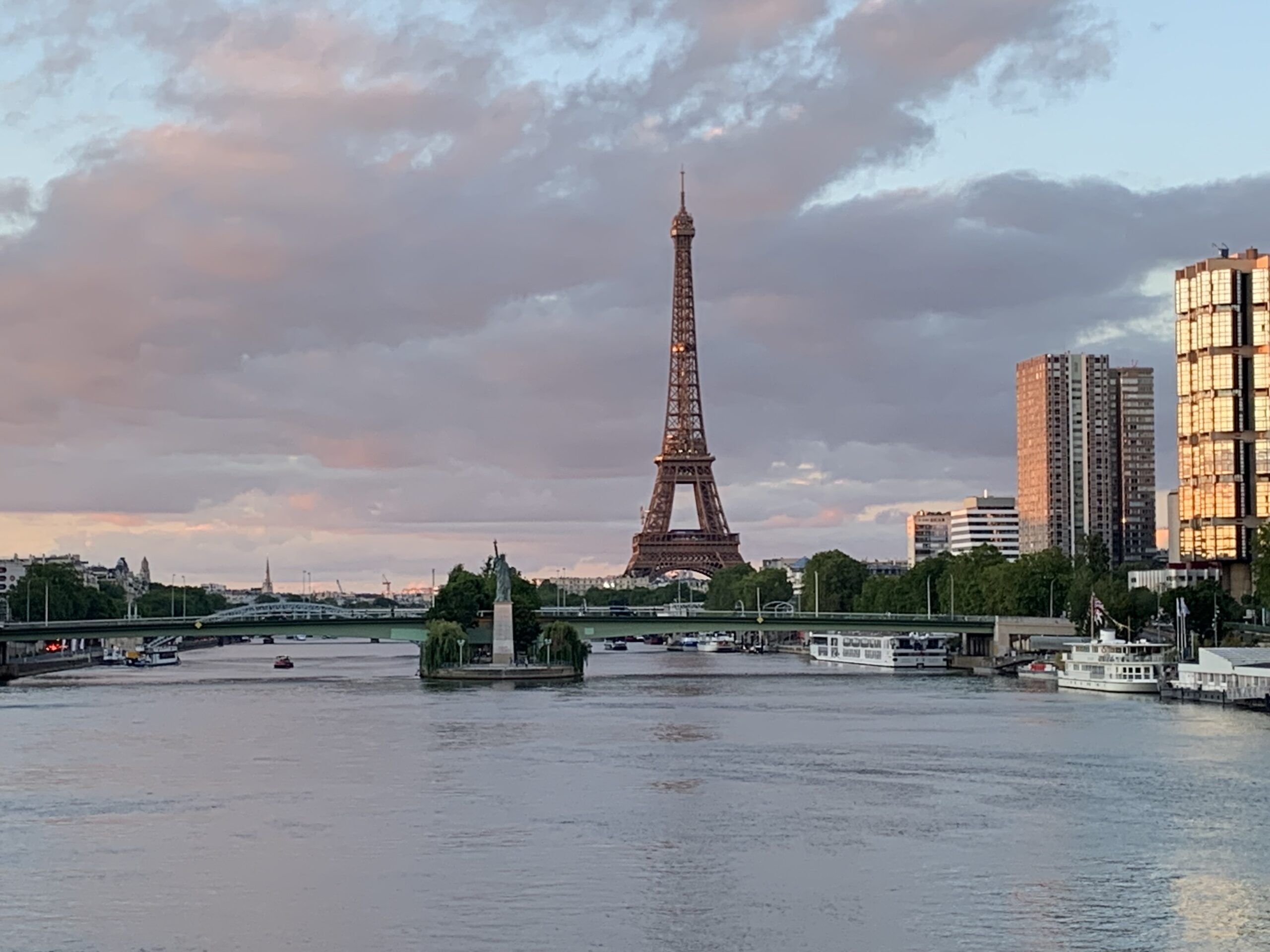
The Eiffel Tower on a beautiful June evening in 2024 (author’s photo).
One person who understands the importance of money is the plainspoken prostitute, Georgette. She gets capitalism at it most primal level as the physical use of her body by men provides her livelihood. She is part of the broader comparison between France and Spain, which Barnes often ties to the issue of money and which will be discussed further down. Georgette speaks directly about what she believes and is realistic about money’s importance. When Jake mentions that a number of people in the crowd they join are “writers and and artists”, she notes approvingly that “Still, some of them make money.”
Everything in France, says Barnes, is run on a financial basis. Later in the novel Barnes talks about the importance of tipping in France as a way to smooth interactions with waiters. One of the first important scenes regarding money appears in Chapter Four when Jake is examining his mail and checkbook. He looks carefully over his statement, deducting checks from his account and writing the current amount on the back of the statement. There’s a bit of the Ben Franklin thrift tradition in this scene. Unlike other characters in this book, Jake is mindful of his cash and accounts, but he also enjoys his purchases, whether they’re drinks and food or bullfight tickets.. He respects the material goods, whether it’s fishing equipment or a Spanish wineskin. He also has the resources to help bail out people like Brett.
Jake’s work ethic and financial management stand in stark contrast to Brett Ashley and Mike Campbell. Brett receives alimony payments from her soon-to-be ex-husband, possibly has some family money, while Mike awaits an inheritance from his family, but the two frequently run up debts and have to be bailed out by others. Brett uses the Count’s money to pay off the concierge at Jake’s apartment house to get access to Jake after her first late night visit with the Count.

Notre Dame, June of 2024 (author’s photo).
Mike is the biggest offender when it comes to money. He is waiting for an inheritance but he has some form of allowance and repeatedly borrows money from friends and leaves behind a legacy of bad blood in his wake with his inability to pay back. Bill and an American friend of his named Edna are out with Mike in Chapter 17 when they run into some people Mike had borrowed money from in Cannes. It leads to a row that gets the three of them tossed from the bar. This is a foreshadowing of the building tension that will result in Cohn’s violence just a short time later.
Mike’s destitution is further revealed after Mike, Jake and Bill depart from Pamplona. The men gamble for drinks, with Bill jokingly referring to Mike as “Old Mike the spender” and “Old Mike, the gambler.” The joking stops when they learn that he is down to his last twenty francs. Mike discussed his dour financial situation with them and informs them he can live “on tick at this pub in Saint Jean.” Bill soon suggests getting a drink–a common solution in this book to whatever is going on– with Mike adding that it’s a “damned good idea” and that “One never gets anywhere by discussing finances.”
In the damaged world of these veterans, there is a clarity and straightforwardness about financial transactions that seems to ease and simplify life. One of the most well known examples is a drunken Bill Gorton’s bit about purchasing a stuffed dog: “Mean everything in the world after you bought it. Simple exchange of values. You give them money. They give you a stuffed dog.” Count Mippipopolous is a man who understands the transactional world clearly. He appreciates the good material things in life and is willing to pay for them. He is also willing to pay for experiences, like simply being with Brett Ashley.
Jake and Bill are also people in a position to bail people out. Jake comes to the rescue of Brett at the end, and we learn that Bill loaned money to the black American boxer who ran into trouble over in Vienna. Looming over this story are the economic layers of society. There is a cast of workers who facilitate and support these travelers: policemen, bartenders, poles, taxi drivers, concierges, street vendors, waiters and other workers. Beneath the realities of everyday commerce are subterranean economies—prostitution is one, smuggling is another. When they cross into Spain they see a man attempting to bring a kid (baby goat) across the border. He is turned away, but one of the Spanish policemen tells Jake he will simply wade across the river to evade border security.
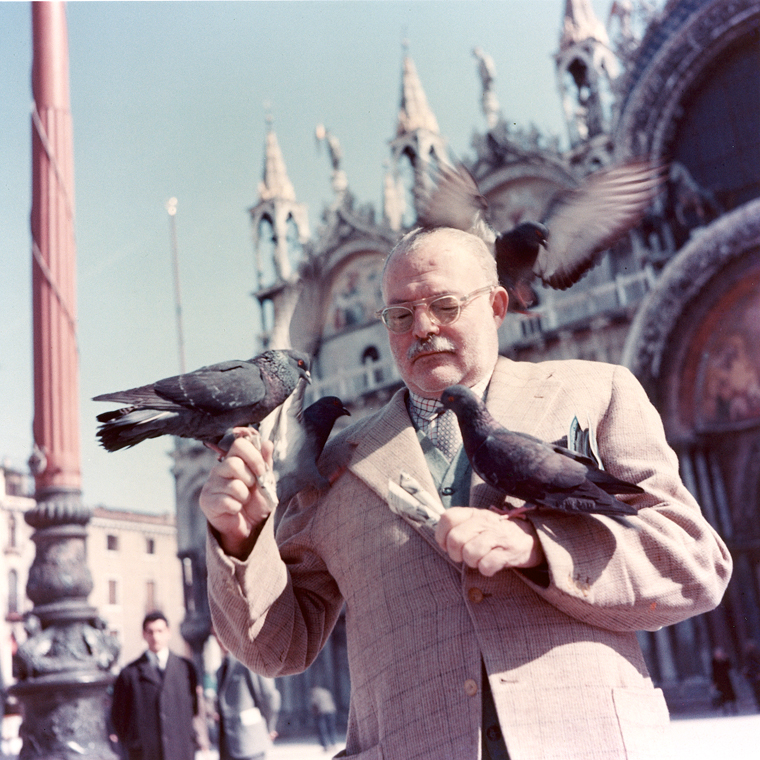
Ernest Hemingway with pigeons, Piazza San Marco, Venice, Italy, 1954. Ernest Hemingway Photograph Collection, John F. Kennedy Presidential Library and Museum, Boston.
There is also an awareness of economic reality, the fact that money can run out–and that social atmosphere can drive expenditure. In Pamplona, Brett points out a place where they can get alcohol as funds dry up. Jake also mentions the Spanish country people coming in for the fiesta. They are moving from one economic reality to another as the bacchanal gets underway. Jake writes that “They had come in so recently from the plains and the hills that it was necessary that they make their shifting in values gradually. They could not start in paying cafe prices. They got their money’s worth in the wine shops. Money still had a definite value in hours worked and bushels of grain sold. Late in the fiesta it would not matter what they paid, nor where they bought.” There will be a shifting of values for others beside the Spanish peasants during the fiesta.
But there is a sense of a deeper order here in this novel, one based on values beyond the economic. The Count understands “values”–he will get his money’s worth, but he does so knowing a price must always be paid and that everything in life has some kind of cost. While the Count apparently owns a line of sweet shops in the U.S., he also seems to have been a mercenary and adventurer, since he has served in “seven wars and four revolutions.” He shows wounds in his side from arrows. His epicurean approach to life is grounded in knowledge of life and death. He would like to be with Brett, but even if he cannot, he will enjoy her company. He has made peace with life and stands in sharp contrast to men like Robert, Jake, and Mike.
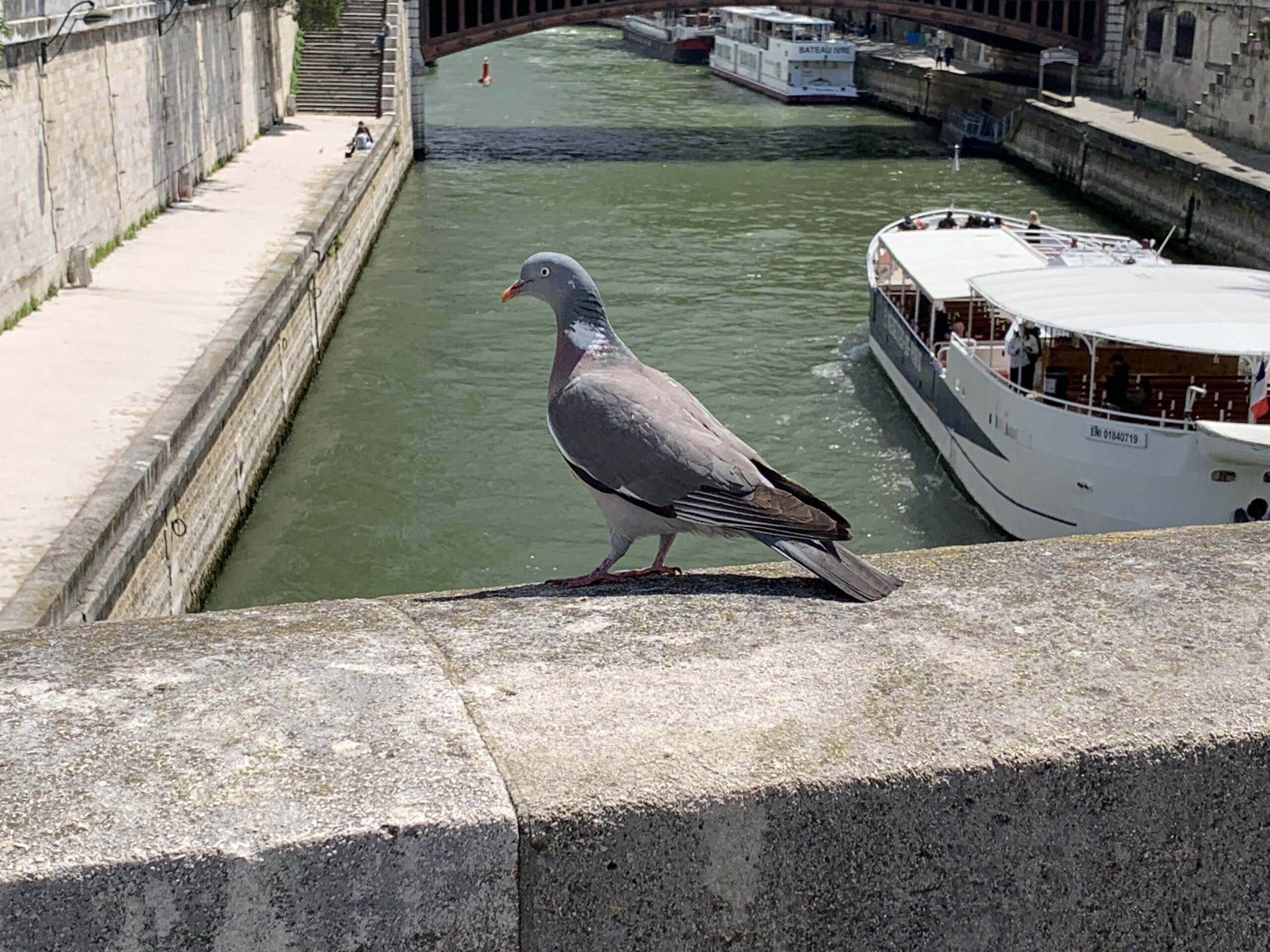
A pigeon of Paris, June, 2024 (author’s photo).
The action in the corrida (bullfight) and much of the action in Spain is a repudiation of the transactional world. When Cohn proposes betting on the bullfights, Jake replies that it “would be like betting on the war” and adds “You don’t need any economic interest.” The gift of fishing flies from Harris is a repudiation of money and the transactional way of life. It comes simply from the heart in appreciation for the time spent with the other men on the river.
Looming over all the interactions in this novel is a sense of cost, of a price to be paid. At one point Brett asks Jake, “Don’t we pay for all the things we do?” In Chapter 14, we get an extended reflection from Jake on his relationship with Brett Ashley:
“The bill always came. That was one of the swell things you could count on. I thought I had paid for everything. Not like the woman pays and pays and pays. No idea of retribution or punishment. Just exchange of values. You gave up something and got something else. Or you worked for something. You paid some way for every thing that was any good. I paid my way into enough things that I liked, so that I had a good time. Either you paid by learning about them, or by experience, or by taking chances, of by money. Enjoying living was learning to get your money’s worth and knowing when you had it. You could get your money’s worth. The world was a good place to buy in. It seemed like a fine philosophy. In five years, I thought, it would seem just as silly as all the other fine philosophies I had.”
On one hand, this seems close to the Count’s philosophy. But the Count operates without any illusions. The way he deals with Brett Ashley is completely opposite from both Jake and Robert. He is integrated and self-sufficient. But Jake is beginning to learn to pay the price of self-knowledge. Just a short time later, in Chapter 15, Jakes discusses the art of the corrida and contrasts the pure form of Romero with the slickness of the professional bullfighters, writing “all that was faked turned bad and gave an unpleasant feeling.” Jake will learn, after his betrayal of Montoya and the practice of aficion, how much his own false values cost him and choke down the unpleasantness he feels as a result.
FRANCE, SPAIN, AND THE OTHER FRANCE–BAYONNE:
The action in The Sun Also Rises begins in France, moves to Spain, returns briefly to Bayonne in France, and then concludes with the meeting of Jake and Brett in San Sebastian when Brett summons Jake there. There are often readings of this novel that contrast France unfavorably with Spain, particularly the scenes in Paris. The city in particular is associated with decadence, sterility, and transactional ways of navigating society, while Spain is considered a land of grounding traditions and values. There is much to support these readings. We should remember though that Hemingway had a deep love for France as well as Spain, and one of the most evocative scenes in the novel is the short description of Jake enjoying coffee and brioche the morning after Brett’s first late night visit to his apartment. There is a lover’s knowledge of Paris and its street scenes in his prose. Hemingway knew these places in France and Spain well, and his expert knowledge shines through in his descriptions. We have some of the best examples of his writer’s craft in his brush stroke descriptions: Marshal Ney’s statue “standing among the new-leaved chestnut-trees in the arc light,” or “There was a low, dark room with saddles and harness, and hay-forks made of white wood, and clusters of canvas rope-soled shoes and hams and slabs of bacon and white garlics and long sausages hanging from the roof.” Some of Hemingway’s finest descriptive work appears in Romero’s masterful handling of the bulls in the concluding bullfight.
While French society is pictured as heavily transactional, relationships between people in Spain are grounded and warm. One of the richest scenes is the one in which Jake, Bill, Brett and others are pulled into a drinking party in one of the taverns in Pamplona, and the Spaniards have them to share the large bowl of tuna, garlic and olive oil. Jake goes down the street to buy some wineskins. The owner asks if Jake wants to sell them. Jake says no and that he wants them for drinking. The men give Jake a good price on the wineskins. There’s yet another example of neighborliness before Jake goes into the shop. He asks a man on the street where he can buy wineskins and the man takes him by the arm and directs him to the shop. There’s an ease and openness with the Spanish people. Jake feels so deeply about Spain that he rubs his fishing rod case in the dust as a gesture of connection with the Spanish earth before departing for France.
It’s also worth remembering that while Paris dominates the early parts the novel, there is another section of France that we visit in the company of Jake Barnes and Bill Gorton. This is in southwestern France close to the Spanish border, and Bayonne is part of the French Basque Country, a part of France with deep cultural and linguistic ties with the Spanish Basque country across the border. Jake gives us a brisk description of the town with its fresh, seaborne air, its pigeons out in the square and the houses, which are a “yellow, sun-baked color.” On the way out of town they see pelota courts, rich farmlands, gardens and churches.
Hemingway’s book helped make the San Fermin festival even more of a destination than it already was. One of the great charms of this work is its vivid sense of life, no matter how damaged its characters are. I’m not the only reader who’s read this book and then wanted to hit the road to Paris, Pamplona, Bayonne and San Sebastián. Hemingway was a superb traveler with a feel for places of all kinds, and it shows in his work.
CATHOLICS, PAGANS AND CLEANSING WATERS:
Religion, the search for meaning, churches, pilgrims, pagan rituals–The Sun Also Rises is full of matters of the spirit. We could argue that it is a book fundamentally concerned with religious issues as we have so many broken people trying to surviver in a broken modern world. Religious identity surfaces early in the novel with the mention of Cohn’s Judaism. We learn that Jake Barnes is a troubled Catholic, and the looming presence of Notre Dame appears when Jake and Bill are making their way through Paris.
The book is riddled with Catholic motifs. The San Fermin festival when the bullfights occur is actually a religious festival, and Masses and religious processions are part of the week long events. On the train out of France, Bill and Jake encounter a carloads of Catholic pilgrims from Dayton, Ohio bound for Lourdes, the site where the Virgin Mary appeared to Bernadette Soubirous, later St. Bernadette, in 1858. Lourdes still draws millions of people for its reputed healing waters.
There are a couple of interesting aspects to this scene. One is how religious pilgrimage meets up with big business and modern travel. Rather than a lonely group of pilgrims walking a country road, we have the modern railway transporting them in large numbers. There’s money to be made in pilgrimage. Keep in mind we are in the 1920s, when American businessman Bruce Barton wrote a book called The Man Nobody Knows, which portrays Jesus as someone who took men from the bottom ranks of society and created the greatest organization of all, or when one church rang a bell every time a dollar dropped in the collection plate. The sheer number of them overwhelms the dining car staff as Jake and Bill have to wait longer to eat. It’s irritating enough that Bill audaciously jokes with one of the priests that his and Jake’s frustration is enough to “make a man want to join the Klan.” Bill’s comment highlights another aspect of 1920s life: the revived Ku Klux Klan of the 1920s had widened its targets beyond black people to include Catholics and Jews. Bill also oddly refers to them as “Pilgrim Fathers,” conflating the Catholic Church with the Puritanical tradition in America that drew the ire of H.L. Mencken and other intellectuals.
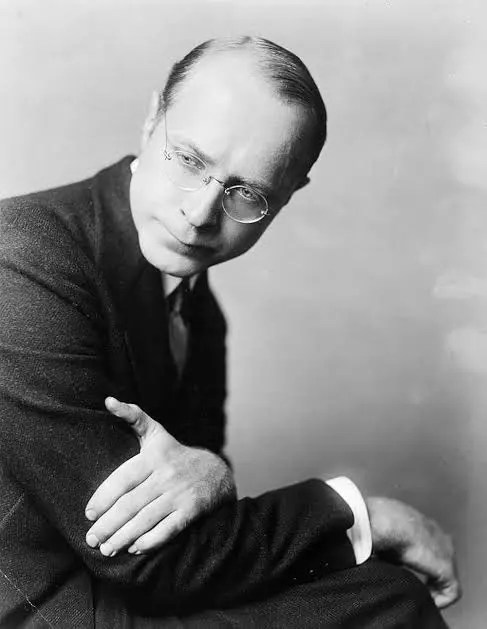
Donald Ogden Stewart, writer, friend of Hemingway and one of the models for Bill Gorton.
On the other hand, the sheer devotion of the pilgrims—people willing to fork over money to travel across the ocean and then by rail deep into France not for debauchery in Paris but for spiritual and physical healing–stands in sharp contrast to the acerbic response of Bill. There will be a visit to healing waters for these two men, but it will be on the Irati in Spain.
During their time in Spain, Jake, Bill and Harris visit a monastery. One of them finds it unsatisfying. The message seems to be that for these wounded, the church does not suffice, or that there is some element missing from modern Christianity. Jake himself goes to confession, but later pronounces himself “a rotten Catholic.”
Jake struggles to find comfort in his Catholicism. Not long after arriving in Spain, Jake goes to the cathedral and prays. He prays for his friends, including Cohn, and the bullfighters he likes. He also prays for some good fishing and for some more money. There’s a bit of quiet, all-too-human comedy in this scene, as when he writes that he prays for “all the bull-fighters, separately for all the ones I liked, and lumping all the rest, then I prayed for myself again, and while I was praying for myself I found I was getting sleepy….” He thinks of the Count and wonders what he’s up to. Jake then writes he felt “a little ashamed and regretted that I was such a rotten Catholic, but realized there was nothing I could do about it, at least for a while, and maybe never, but that anyway it was a grand religion, and I only wished I felt religious I would the next time..” Jake is soon back outside in the hot sun of Spain, and there’s a sweet bit of writer’s craft when Jake mentions that “the forefinger and the thumb of my right hand were still damp, and I felt them dry in the sun”–he has dipped his fingers in the holy water on the way out as a good Catholic should.
Jake’s impotence goes beyond the physical. His Catholicism is more a nature of gestures, of loose affiliation. He prays in a wandering fashion, goes into the church, dips his fingers in the water, but he doesn’t go below the surface. His faith is parched. The broken ones like him are unable to find consolation in religion. Another reality worth considering is that Jake Barnes is by any measure a raging alcoholic. Getting sober and away from booze would be a good first step on the real road to healing and some meaningful connection to the Church, which would also mean an effort on his part to engage more deeply with his faith. I have to wonder though—and perhaps this is part of Hemingway’s submerged iceberg–that maybe Jake senses these people can’t help him, that they wouldn’t understand his problems. We never see Jake actually engage with a priest, monk or nun who could provide some comfort. He is passive; he doesn’t look for help, but his reservations are understandable. Psychology and therapy were in their infancy and suspect to many. There was valuable work done during WWI to address what was known as “shell shock,” especially by British Army Captain W.H.R. Rivers, but deeply widespread cultural assumptions in both the United States and Europe valued “getting on with it,” accepting very difficult experiences as part of life, stuffing those feelings down and moving on. I have to wonder too if it would be frustrating for Jake to discuss his wound and love for Brett Ashley with people who have chosen chastity as part of their religious commitment.
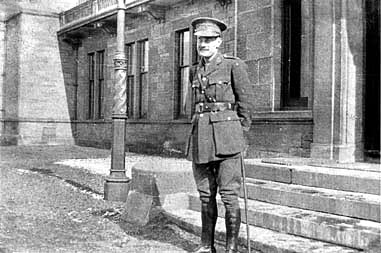
Captain Rivers.
This religious aspect of The Sun Also Rises underscores a difference between then and now regarding trauma. He is caught in time between two worlds. The Catholic Church and many other Christian denominations today recognize the benefits of secular psychology. It varies from denomination to denomination, but many pastors have some degree of pastoral counseling training and most Catholic, Eastern Orthodox and mainline Protestant denominations recognize the reality of PTSD, offering support for those suffering from it and referrals to therapists with pastors offering more emotional and spiritual support. If Jake went to a priest or nun today and spoke to them candidly about his condition, he would likely find someone who would listen and intellectually understand the problem and offer support and resources. Jake has the potential to be different kind of code hero–one who takes action, but this time in the service of his own soul and redemption–but where to turn? Instead he drinks to excess, stuffs his emotions down (as so many did then and often do today) and marinates in his own despair.
The landscapes of France and Spain these characters occupy are ancient, full of lore, history, and culture. But they seem to find away from the festival solace only in nature, which is solace to be sure, but it is not enough. Connection with nature is one grounding force, but healthy people also need community and a sense of purpose. Another example of a lack of connection between these wounded and the traditional structures appears when Jake, Bill and Wilson-Harris visit the monastery at Roncesvalles. This is what is said:
“It’s a remarkable place,” Harris said, when we came out. “But you know, I’m not much on those sorts of places.”
“Me either,” Bill said.
“It’s a remarkable place, though,” Harris said. “I wouldn’t not have seen it. I’d been intending coming up each day.”
“It isn’t the same as fishing though, is it?” Bill asked. He liked Harris.
“I say not.”
We were standing in front of the old chapel of the monastery.
“Isn’t that a pub across the way?” asked Harris. “Or do my eyes deceive me?”
“It has the look of a pub,” said Bill.
“It looks to me like a pub,” I said.
“I say,” said Harris, “let’s utilize it.” He had taken up utilizing from Bill.
Here is an excellent illustration of Hemingway’s iceberg theory in action. They are standing in a beautiful borderland area drenched in French and Spanish history, a nexus of medieval pilgrimage, legendary battle, and the origins of the French literary masterwork The Song of Roland. Built in the 12th century, the monastery was a way station for pilgrims traveling deeper into Spain and remains so today. It was in this valley in 798 that the entire rearguard section of Charlemagne’s army was cut down to the last man by Basque warriors, an episode that inspired The Song of Roland, the French national epic. Visiting the monastery would have exposed them to not only an evocative atmosphere that recalled ancient times, but to stunning artifacts.
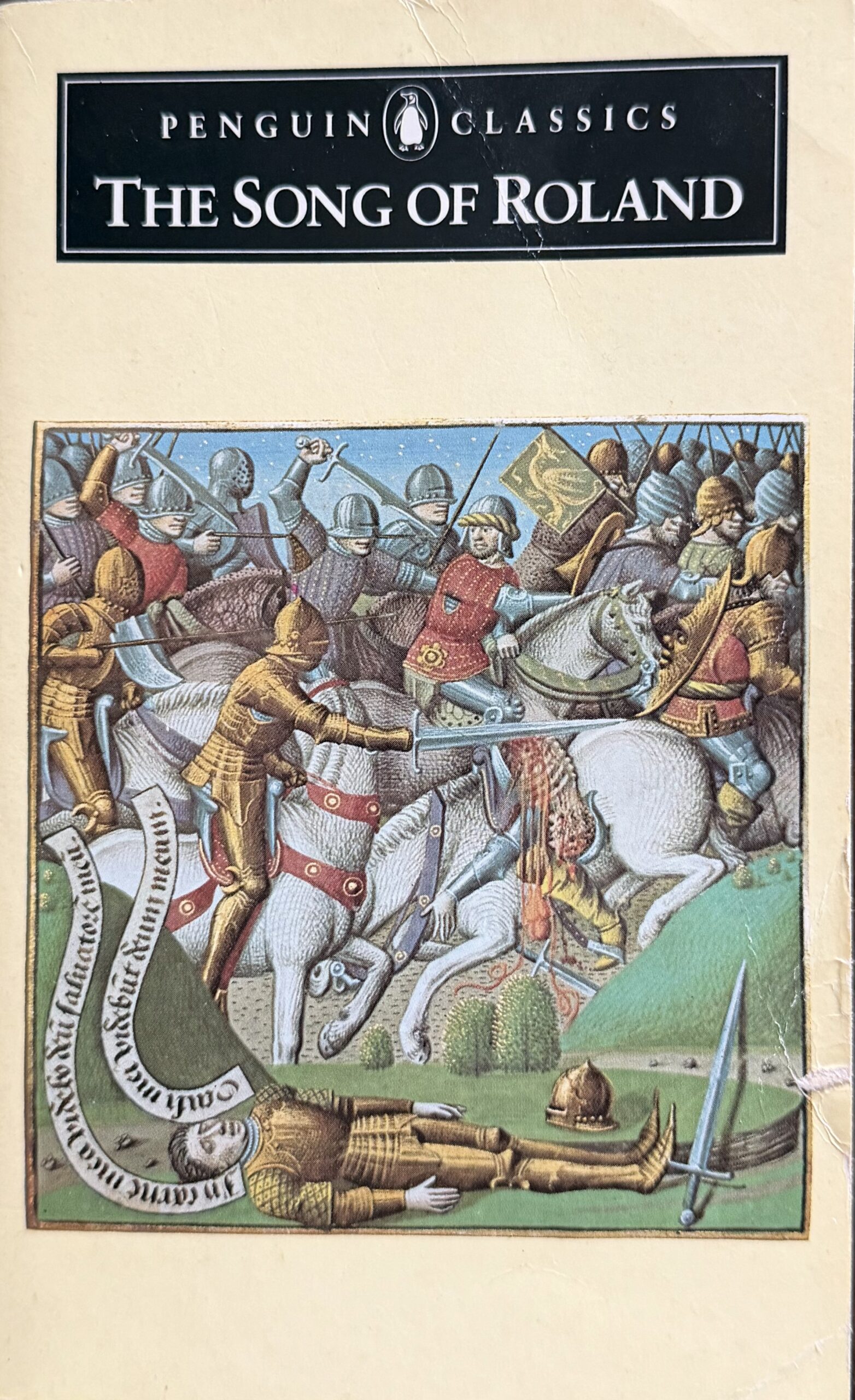
The Song of Roland (author’s photo).
These are intelligent, thoughtful men. Two of them are writers. One would think this site would interest them more, hold greater power, stimulate their imaginations and remind them of the great sweep of history. But they are numb and underwhelmed. This world of ancient legends and heroism is too remote to them, too far gone in the past for men who have just witnessed the mechanized slaughter of The Great War of 1914-1918. It might remind them of the tales of remote valor they grew up on as schoolboys and discarded after the reality of industrial warfare. Or perhaps even this long ago battle is too close in time for the three of them to their own collective ordeal in WWI. The battle here was as gruesome and appalling in its own way as the slaughter of WWI, involving vicious hand to hand combat with javelins, swords and other bladed weapons. This passage also reveals that traditional religion holds little consolation for these people, even for a Catholic like Jake Barnes–or maybe Jake decides to just keep quiet.
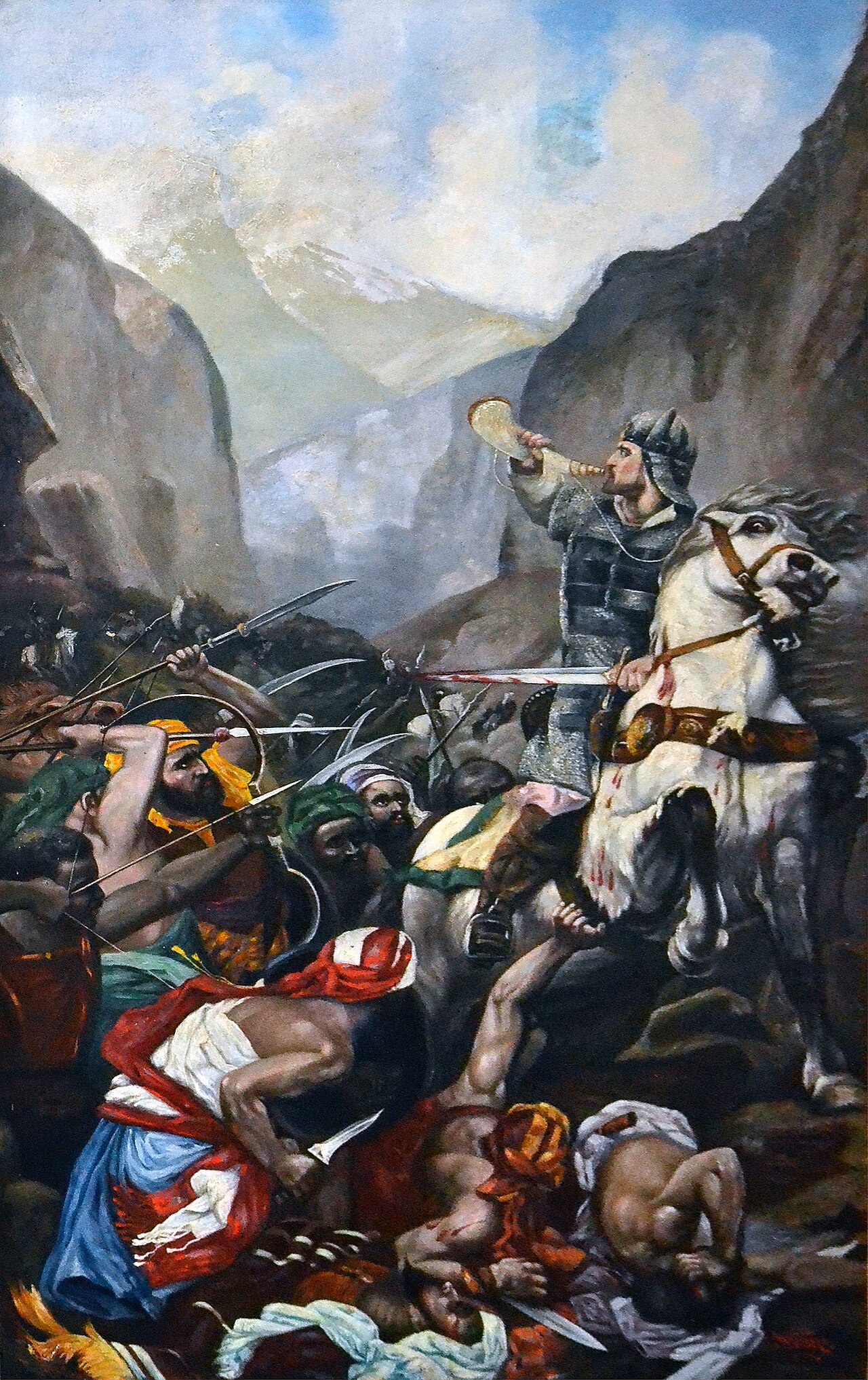
Roland blowing his horn at the Battle of Roncevaux Pass.
For them, solace is found while fishing in the healing waters of the Irati River, and this makes sense. In our own time we have seen remarkable growth in treatments for trauma, especially post-traumatic stress disorder. One of those therapies for combat veterans is time in nature. They enjoy their time on the river, and Harris is sad to see them go. He tells them he hasn’t had such a good time since the war—the implication being the connection he had with his brothers in arms–and he gives both a simple but wonderful gift: fishing flies he made himself. It’s a warm moment in a book full of surface living. But we shouldn’t overlook what holds their attention when they exit the monastery—a pub where they can go and drink down the loss and pain. The word “utilize'” shows up here, a term Bill has enjoyed using and Harris has picked up, but it echoes the transactional nature of too many interactions in this book and industrial efficiency. They are pilgrims without faith.
In sharp contrast to the wavering Catholic Jake is the Dionysian figure of Brett Ashley. Aside from her identification as “Circe” by Robert Cohn, there are a number of pagan associations to Brett. She is barred from entering a church because she isn’t wearing a hat, an interesting development given her hats received some attention in the book, although I wonder if her beret or fedora would have passed muster with the churchmen. Directly following her rebuff from the church, a crowd encircles Brett at the Pamplona festivities and dance around her. The dancers have garlics around their necks and Bill and Jake are pulled into the dancing circle. We learn that “Brett wanted to dance but they did not want her to. They wanted her as an image to dance around.” Following this Brett is pulled into a wineshop and seated on a wine cask. The dancers place garlics around her neck. She is instructed on how to drink from the wineskins as Jake and Bill were on the bus ride.
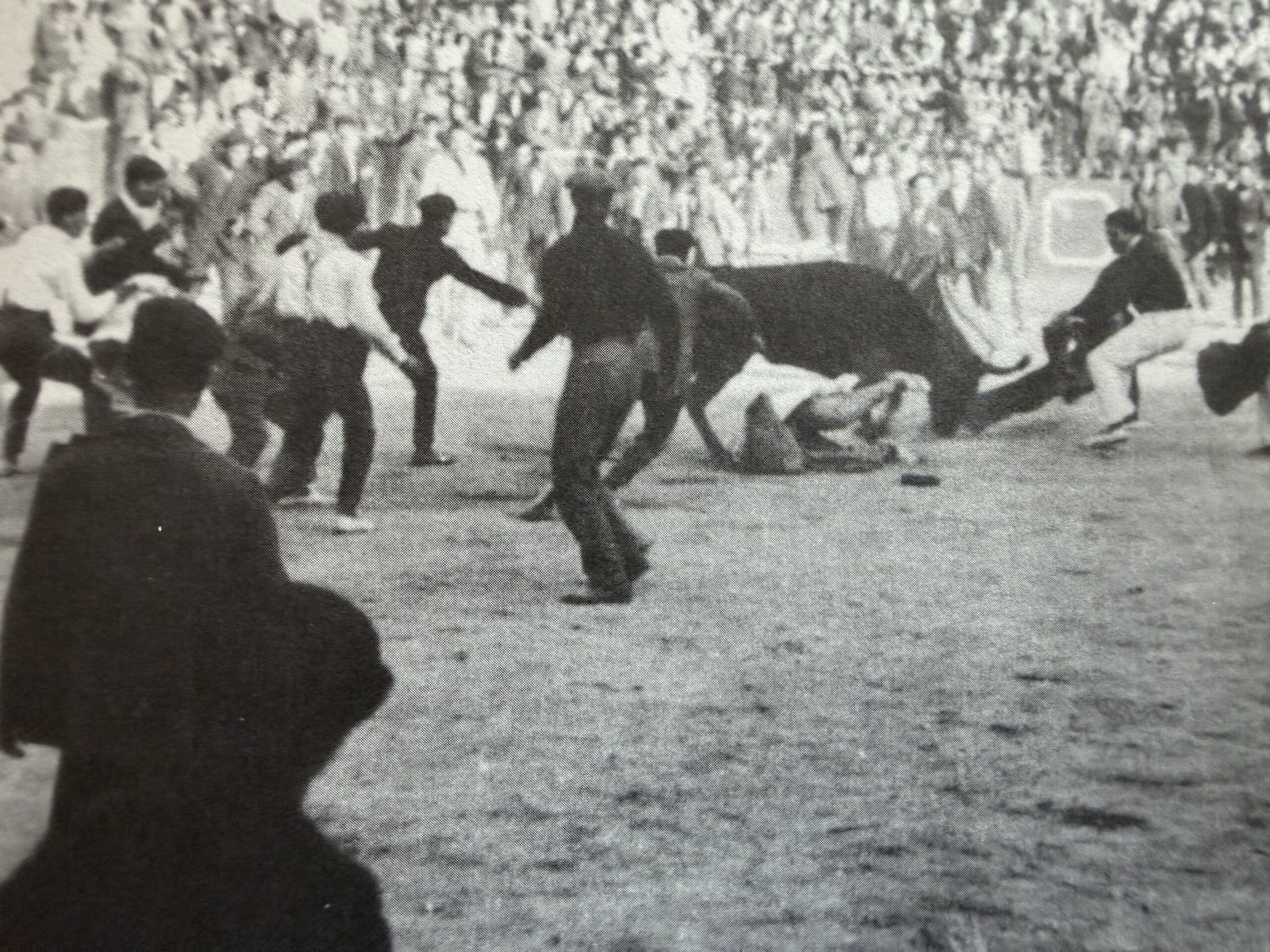
Hemingway at far right in white pants tussling with the bulls in Pamplona.
There is also an interesting moment when a Spanish woman calls to her daughters to come out and look at Brett. The scene is ambiguous. One critic I read thought this was because she wanted these women to see Brett’s beauty. I took it the other way. I suspected she wanted them to look upon this foreigner who is defying convention.
Brett is remote from traditional Christian faith. Not long after their arrival in San Fermin, Brett does accompany Jake to church. Her ignorance of traditional faith is revealed when she asks Jake if she could listen in on his confession—a startling and clueless request, which Jake reminds her is “impossible” and reveals a lack of respect for his privacy and remarkable lack of understanding of what an important ritual this is. It is the confession of sin. Jake also rebuffs her by saying “it was not as interesting as it sounded, and, it would be in a language she did not know.” These last words are important and go beyond the matter of Spanish. It is the language of the church, of contrition, of penance, a realm she doesn’t occupy. This is a refreshing example of Jake Barnes saying a well merited “no” to Brett Ashley. He’s not entirely independent here–he’s got the backing of the church on this one–but I find it uplifting to see him set some kind of boundary on her. Brett soon finds herself on more comfortable ground. They take a walk to a gypsy campground along with Cohn, who has been following them, and Brett gets her palm read. This is her kind of confession booth. There’s a nice symmetry to these scenes.
There is one last scene with Brett in a church. In chapter 18, after Cohn has punched both Jake and Mike and brutally pummeled Romero, Brett and Jake step into the church of San Fermin. She says she wants to pray “a little” for Romero. She soon asks Jake if they can leave, saying she feels “damned nervous.” Outside she tells him she is “damned bad for a religious atmosphere” and that she has “the wrong kind of face.” It’s quite possible that Brett Ashley grew up with some kind of religious background in England. She seems to want a spiritual connection, but her level of estrangement from churchly institutions seems firmly established.
The festival in Pamplona blends pagan and Catholic elements. There is the actual Catholic religious festival, but a pagan flavor seasons the uninhibited behavior that occurs there and with the corrida itself. The Church has long opposed bullfighting, both for its treatment of animals and its roots in pagan Rome and the cult of Mithras. But because the tradition has become so deeply intertwined with Spanish culture, the Church’s position is deeply relaxed in Spain, with some priests blessing the bullfights.
Lastly, water is an important element in The Sun Also Rises. One of the most prominent examples is the previously mentioned Irati River, where Jake, Bill, and Harris spend hours fishing. It isn’t just the river–it’s also the spring pocketed in the earth where Jake places his bottles of wine to keep cool. A number of times in the book Brett says she “must bathe.” indicating a need for some cleansing ritual. Towards the end of the festival in Pamplona there’s a period of time when it rains, bringing a period of calm and quiet to the days of rowdy drinking, dancing, and bullfighting. The penultimate example of the healing power of water is when Jake swims in the sea at San Sebastián. Here, after the debacle of pandering Brett to Pedro Romero, Jake finds some sense of absolution when he dives deep into the bracing waters. It is this baptism in nature that helps give him the strength to face Brett for the last time and chart a new course.
AFICION AND “THE CODE”:
Hemingway would become known for his “code” characters. The Hemingway code hero is a man who is solid. He keeps it together, he patiently endures suffering and doesn’t complain or whine about his lot. There is much of the Stoic in him. He has found a way to exist in the harshness of the world. He has a great respect for craft. When he does something, he does it to the best of his ability. Barnes is not quite there yet, but by the end of the book he seems to be on his way, however slowly. The Count is more of the code hero until we get to Pamplona, and there we meet the code hero of Spain: a young man only 19 years old, but a brave and gifted matador. It isn’t just that Pedro Romero is skilled–the slick, professional bullfighters that draw the ire of Jake and Montoya are skilled too–but there is a purity and devotion to his art, and those with “aficion”–an almost mystical appreciation of the bullfight–can appreciate his excellence and spirit. He withstands the punishing blows from Cohn, but then when Cohn tries to shake his hand he throws a punch of his own.
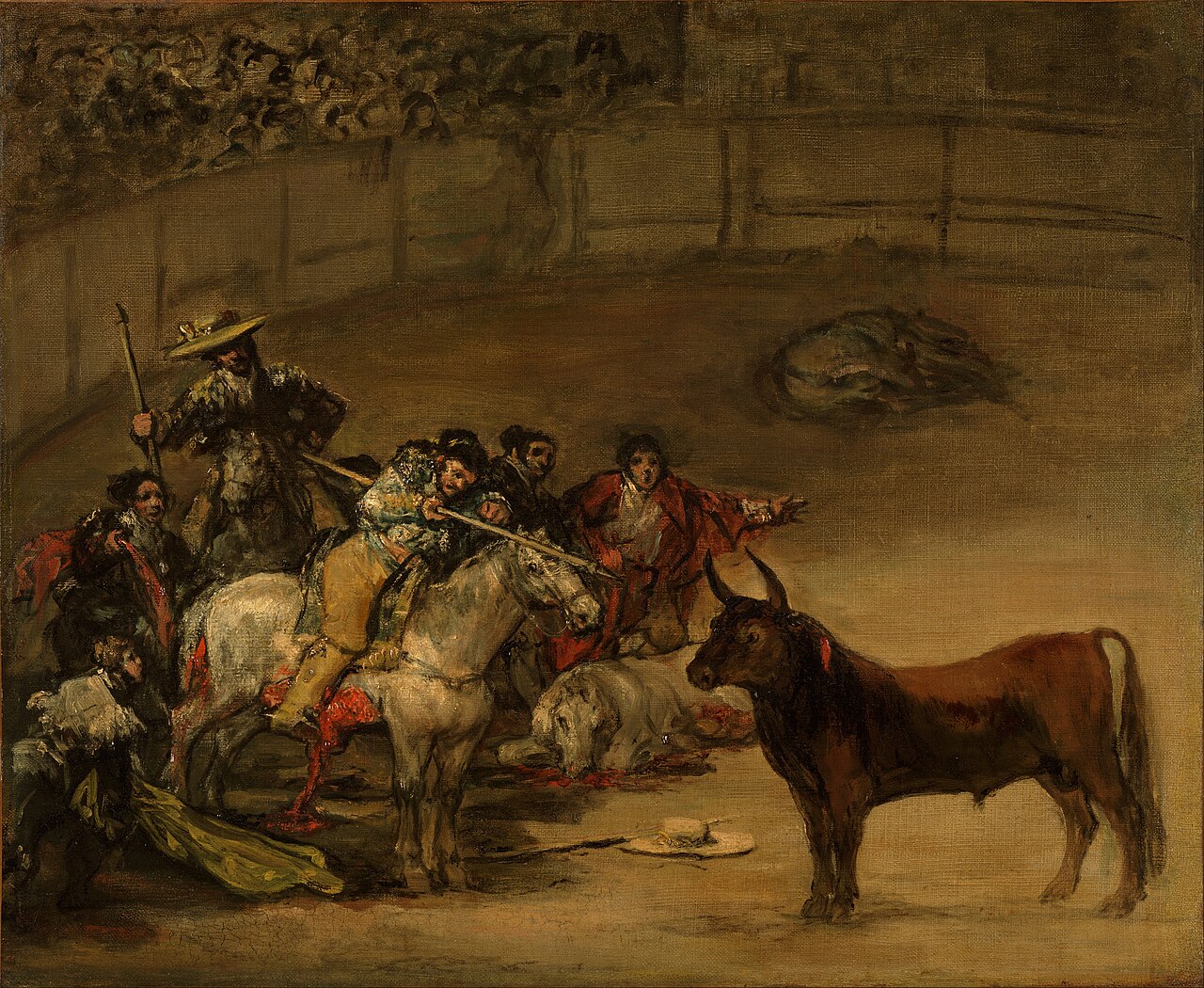
“Bullfight” by Goya.
Despite the brutal beating he endures, he goes into the corrida and performs splendidly. Romero certainly exhibits the grace under pressure quality of the code hero. While I would agree that of all these characters Pedro Romero is most in line with a the code hero, his running off with Brett Ashley threatens to unravel him, putting him in the company of Barnes and Cohn. He wants Brett to marry him, settle down, grow her hair longer and dress in more conventional style. He has lost his head over a woman. It is also worth noting that he has not undergone the brutal ordeals of combat that Jake, Mike and Bill have. He is only nineteen. It’s easier to be a code hero when you haven’t undergone the crucible of The Great War. The fact that Jake has undergone his vicious wounding in the war, has had to live with it, betrays his ideals for the sake of Brett but then shows signs of redemption at the end is to me the more impressive achievement.
JAKE AND BRETT:
At last the fiesta is over. Brett has run off with Romero. Mike, Jake and Bill return to France, where they bid farewell to one another. But Jake is headed back to Spain, this time to San Sebastián. It is here that his renewal begins. We are alone with Jake for a while. He checks into a hotel and goes swimming in the ocean, diving deep down into the water, reflecting on his life. But the peace won’t last long. He receives word from Brett, a request for rescue once again. He goes to her in Madrid, but there is an interesting reversal at work. Whereas earlier Brett arrived at his place and dealt with a gatekeeping chaperone, Jake arrives at her hotel and deals with some difficult hotel staff. At last he meets with her. There is more of sureness about Jake Barnes at this point. He notes the squalor of her room. Brett has had her own epiphany. She sent Romero away. She mentions her age–thirty-four–and says “I’m not going to be one of those bitches that ruins children.” Shortly after she says “it makes one feel rather good deciding not to be a bitch.” This is a big step forward for someone like Brett Ashley.
She will return to Mike, saying “He’s so damned nice and he’s so awful. He’s my sort of thing.” We can be grateful that Brett has learned some limits with her behavior, but she doesn’t seem to have much of a future—but maybe some sense of self-knowledge has crept in. I feel more hope for Jake. When he arrives in Madrid, he notes that the “Norte station in Madrid is the end of the line.” Jake Barnes seems to have come to the end of the line with Brett Ashley. He famously gets the last words in the book, When Brett says, “we could have had such a damned good time together,” Jake responds with “Yes. Isn’t it pretty to think so?” The illusion is shattering, and the bitter knowledge of the code hero is growing inside Jake Barnes.
ROMAN A CLEF: THE BITTER AFTERMATH
Why did he do it? Why did Hemingway write this roman a clef that left others feeling bitter and betrayed and fueled gossip among the bohemians of Lost Generation Paris? The simple answer is because he could and because he felt he had to. Hemingway was desperate for literary success and recognition, felt like he had major novels inside him and was primed to find some situation in his life ripe for fictional treatment. It was what he was looking for. This has been amply and well documented in Leslie M.M. Blume’s book Everybody Behaved Badly: The True Story Behind Hemingway’s Masterpiece The Sun Also Rises. If you want the story of the actual people this story is based on and their time with Hemingway in France and Spain, this is the book to read. Hemingway had been writing short fiction for some time. He had some success publishing in small but influential magazines and had published In Our Time, a collection of short stories and poems in 1925, the year Hemingway made the trip to Pamplona for the fiesta and bullfighting that is such an important element of The Sun Also Rises. A shorter version of In Our Time appeared in 1924.

Hemingway not long after his arrival in France. This photo was taken by Sylvia Beach of the famous Shakespeare & Co. bookstore in Paris.
Hemingway was yearning to write the big book that would make his name. He was ravenous for success and felt time was ticking away. He had great confidence in his talent and a powerful, disciplined work ethic. He was also envious of the success his friend Scott Fitzgerald had and felt he could do likewise. He hungered to create a work propelling him into the front ranks of the new Modernist literature alongside writers such as Fitzgerald, Joyce, and Eliot. He found the perfect story in the events in Pamplona. But all of this came at a cost. Hemingway was persona non grata to many in Paris after its publication. People like Duff Twysden were deeply upset and felt horribly betrayed. One of the ugliest aspects was Hemingway’s treatment of Loeb. While Loeb did share some of Cohn’s characteristics, he was also a successful novelist and editor, a friend of Hemingway’s who helped him and supported his writing. He later wrote that nothing he did deserved the treatment he got in The Sun Also Rises. The antisemitism directed at Cohn is a particularly troubling aspect of the book. While these attitudes were common among upper class WASP types as well as Klansmen, it’s hard not to feel that Hemingway himself endorses this prejudice. Hemingway did express antisemetic prejudices throughout his life.
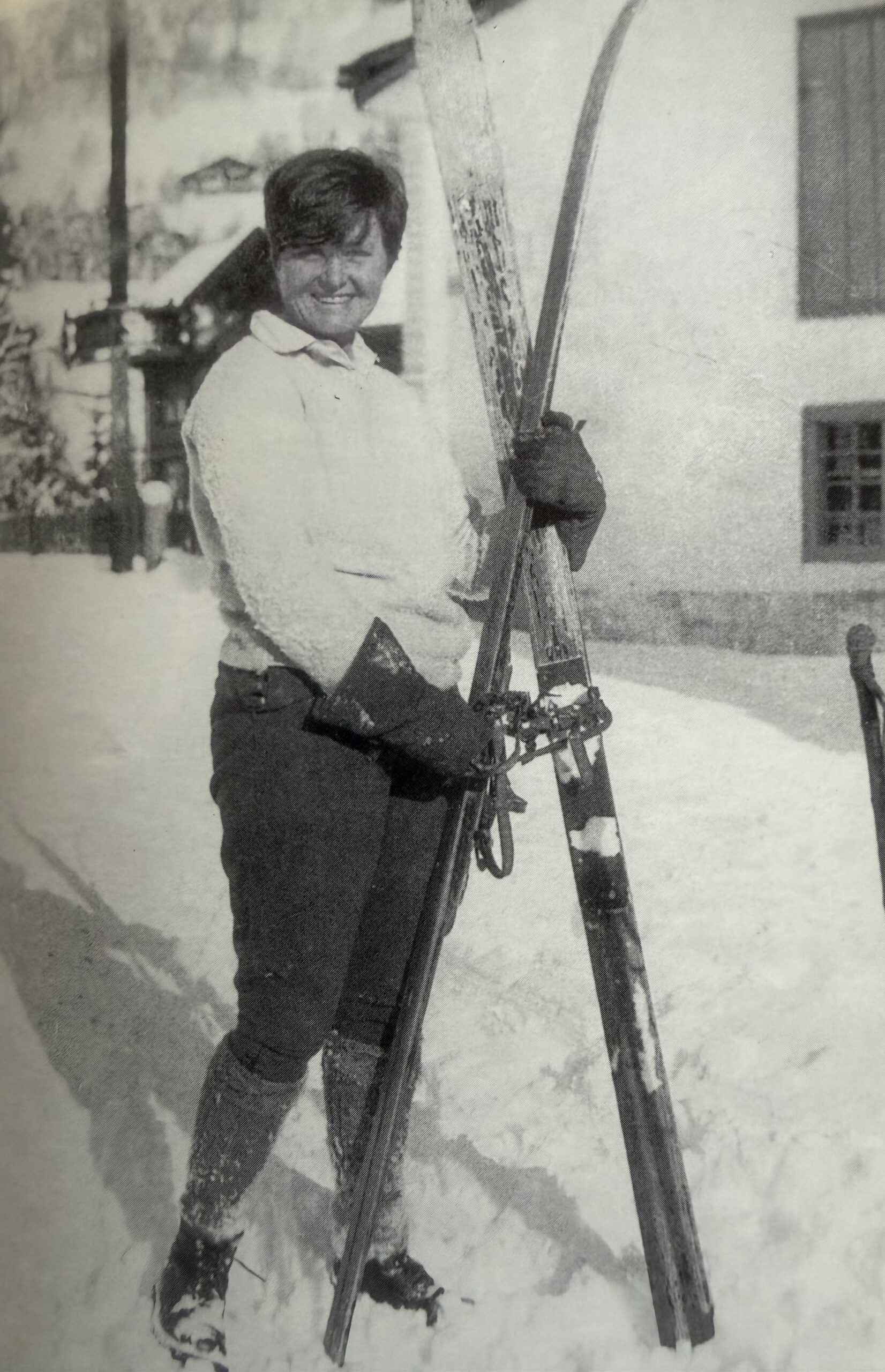
Hadley Hemingway in Austria. Hemingway collection, JFK Library.
Hemingway had a lot of problems. He was deeply insecure. He had fallen for Duff Twysden himself and his marriage to Hadley was slowly unraveling. One particularly weird aspect of this tale is that he wrote Hadley out of the book despite the fact she was there for these events. He wanted his narrator to be in love with Duff/Brett, so it was easier to make Jake a single man, so Hadley had to go. Maybe he felt things would be easier too if he made his hero impotent. Perhaps there’s a strange self-own on Hemingway’s part in making his narrator sterile. In the long run a lot of people were hurt, and feelings about it ran deep for years to come.
AN ENDURING WORK OF FICTION:
Jake Barnes may remind us of Hemingway, but Barnes is fictional. Duff Twysden was not a V.A.D. Harold Loeb was a sophisticated man nine years older than Hemingway who edited Broom. Bill Gorton is a composite of two other men. Duff Twysden did not have a fling with the bullfighter who was a model for Romero. In fact, Duff Twysden in real life seems a lot less sympathetic a character than Brett Ashley. Hadley is missing from the story. Hemingway and Loeb ALMOST had a fistfight, but decided not to. Although closely based on real events, The Sun Also Rises is fiction: a memorable portrait of our modern era, a rendering of the violence to the spirit resulting from modern warfare and the struggle of broken people to cope with profound trauma. The faces and clothing change, but these are our ancestors in the modern world, and their progeny walk among us today.
The book still speaks to us.
Everybody behaved badly–and our literature was changed forever.
Patrick Kerin
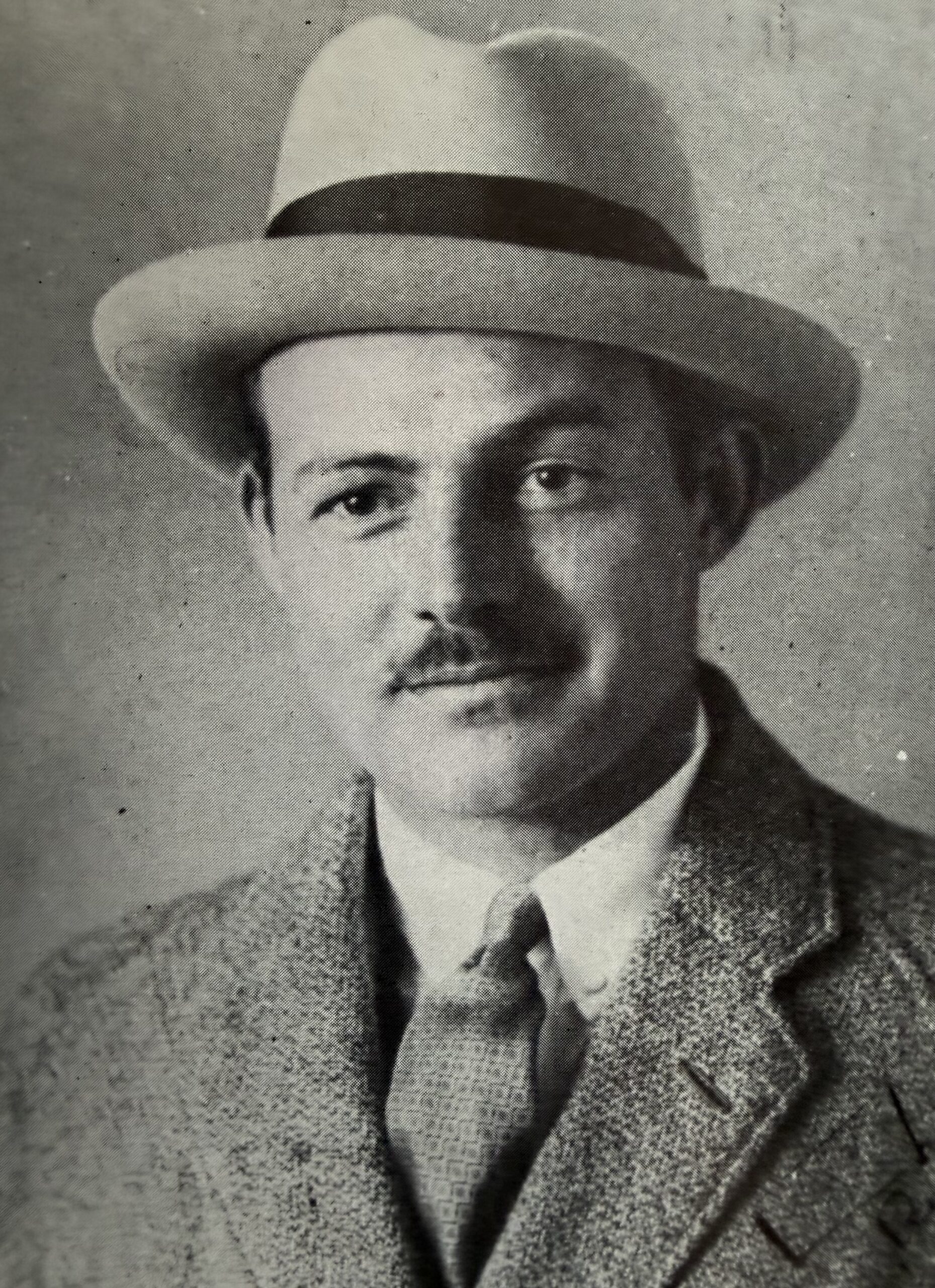
What a thrill to open my email in the early morning darkness and discover that you have once again created a post for your blog! This pleases me on so many levels. First, you are re-introducing me to one of my favorites, one I haven’t read for probably at least 40 years. Next, it is as if I have written to ask you to tell me about the youthful Pat and how your love of literature evolved, and you responded!
My first encounter with Hemingway came in the form of his very short story, A Day’s Wait. The young boy in the story certainly knew that life could be damaged and was finite, not unlike the characters in The Sun Also Rises, of course. I think Hemingway was always convincing his readers and characters that fear is very real even though it might not seem warranted or rational. I recently read Dennis Lahane’s The Given Day. It reminded me of Hemingway though I wouldn’t say it was like his writing, both books certainly highlight lives changed by war. You mention the lack of family background in defining the characters, Lahane’s characters are deeply defined by family.
Anyway, I won’t ramble on but will say that you’ve probably opened a Pandora’s box for me as I struggle to jog my Hemingway memory. And I don’t suppose watching Midnight in Paris will quench my thirst, ha! Thank you for this treasure!
You’re welcome, Ann, and thank you! Your support always means so much to me. I’m struck by how deep his work goes, and to think he was a guy in his mid twenties when he wrote this–it’s astounding. I have always wanted to read Dennis Lahane, so your mention is a good nod to check him out. I’ve read some articles about him and his work has always sounded good. I haven’t read that particular story by Hemingway–I will look that one up. I’m going to go back and tweak this post some and add some more images. Thanks once again. And we all love Midnight In Paris here! What a fun movie! I purchased the soundtrack on CD not long ago. 🙂
Patrick
Congratulations Patrick – a tribute to Hemingway, and to you!!!!
Thank you, Tim, and thanks for all of your wonderful support during the writing of this piece! I will be back in touch with you soon. So glad you checked this out! 🙂
Patrick
Hi Patrick ,
As luck would have it, I am in KW right now and just finished touring the Hemingway House. You could easily get a job there as a tour guide based on your knowledge of EH. The pay is not great (volunteers only), but the weather is good.
Keep up the good work! I enjoy it.
Best,
Patrick
Thank you! What a great place to visit–we were there shortly before Christmas in 2016 and had a great time. Hope you enjoyed all the four legged critters roaming around! Thanks again for your support!
Patrick